Antibacterial activity of a pigment produced by Serratia marcescens FCS2015 using peanut powder as a substrate and different glucose concentrations
Actividad antibacteriana de un pigmento producido por Serratia marcescens FCS2015 usando polvo de maní como sustrato y diferentes concentraciones de glucosa
DOI:
https://doi.org/10.24054/bistua.v23i2.3633Keywords:
antibacterial, fermentations, prodigiosinAbstract
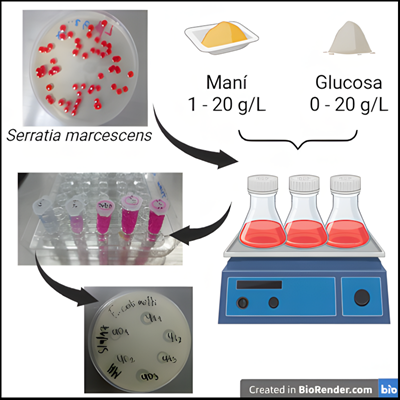
The search for sustainable strategies to obtain pigments with potential uses in industry is increasingly important, especially those that, in addition to presenting a certain color, show antimicrobial and antioxidant activities, among others. Many of these compounds with characteristic colors are produced by microorganisms and their production has been explored in different fermentation systems. Prodigiosin, for example, a bacterial pigment for which antibacterial, antifungal, antiparasitic and even antiviral activity has been reported, is produced by species such as Serratia marcescens in submerged fermentations using various substrates such as casein, peptone, glycerol, and starch. However, some sugars such as glucose when present in culture media can inhibit its synthesis. The objective of this study was to evaluate the production of prodigiosin in culture media supplemented with different concentrations of peanut powder, a substrate rich in lipids and proteins, in addition to determining how the concentration of glucose in these media affects the production of the pigment. The results revealed that the higher the concentration of peanut powder in the culture media, the greater the production of prodigiosin. Similarly, a decrease in pigment production was found as the glucose concentration in the media increased. The antimicrobial activity of the extracts obtained from the cultures in media with low glucose concentration was confirmed by inhibition of the growth of Staphylococcus aureus ATCC 29213 and Escherichia coli ATCC 700891. This work once again confirms the biological potential of the prodigiosin obtained from S. marcescens and it is proposed to carry out toxicity studies for this pigment in addition to new tests of antimicrobial activity using other organisms of clinical and biotechnological interest as controls.
Downloads
References
L. D. Ardila-Leal, R. A. Poutou-Piñales, A. M. Pedroza-Rodríguez, y B. E. Quevedo-Hidalgo, “A brief history of colour, the environmental impact of synthetic dyes and removal by using laccases”, Molecules, vol. 26, no. 13, p. 3813, junio de 2021. Disponible: https://doi.org/10.3390/molecules26133813
S. Sultana, M. M. Rahman, F. I. Aovi, F. I. Jahan, M. S. Hossain, S. A. Brishti, M. Yamin, M. Ahmed, A. Rauf, y R. Sharma, “Food color additives in hazardous consequences of human health: an overview”, Current Topics in Medicinal Chemistry, vol. 23, no. 14, pp. 1380-1393, febrero de 2023. Disponible: https://doi.org/10.2174/1568026623666230117122433
F. C. Lopes, y R. Ligabue-Braun, “Agro-industrial residues: eco-friendly and inexpensive substrates for microbial pigments production”, Frontiers in Sustainable Food Systems, vol. 5, p. 589414, marzo de 2021. Disponible: https://doi.org/10.3389/fsufs.2021.589414
T. B. J. Molelekoa, T. Regnier, L. S. da Silva, y W. Augustyn, “Production of pigments by filamentous fungi cultured on agro-industrial by-products using submerged and solid-state fermentation methods”, Fermentation, vol. 7, no. 4, p. 295, diciembre de 2021. Disponible: https://doi.org/10.3390/fermentation7040295
A. A. Abdelaziz, A. M. A. Kamer, y K. B. Al-Monofy, “Pseudomonas aeruginosa’s greenish-blue pigment pyocyanin: its production and biological activities”, Microbial Cell Factories, vol. 22, p. 110, junio de 2023. Disponible: https://doi.org/10.1186/s12934-023-02122-1
C. Sumathi, D. MohanaPriya, S. Swarnalatha, M. G. Dinesh, y G. Sekaran, “Production of prodigiosin using tannery fleshing and evaluating its pharmacological effects”, The Scientific World Journal, vol. 2014, p. 290327, enero de 2014. Disponible: https://doi.org/10.1155/2014/290327
H. K. N. Kumar, N. C. Mohana, D. Rakshith, M. R. Abhilash, y S. Satish, “Multicomponent assessment and optimization of the cellulase activity by Serratia marcescens inhabiting decomposed leaf litter soil”, Sustainable Chemistry and Pharmacy, vol. 31, p. 100951, abril de 2023. Disponible: https://doi.org/10.1016/j.scp.2022.100951
Additional Files
Published
Issue
Section
License
Copyright (c) 2026 © Autores; Licencia Universidad de Pamplona

This work is licensed under a Creative Commons Attribution-NonCommercial-NoDerivatives 4.0 International License.
© Autores; Licencia Universidad de Pamplona