Genetic diversity of Rubus glaucus Benth in the municipality of Pamplona (northeastern Colombia)
DOI:
https://doi.org/10.24054/bistua.v19i2.1125Keywords:
AMOVA, Blackberry, Genetic diversity, PCR, PICAbstract
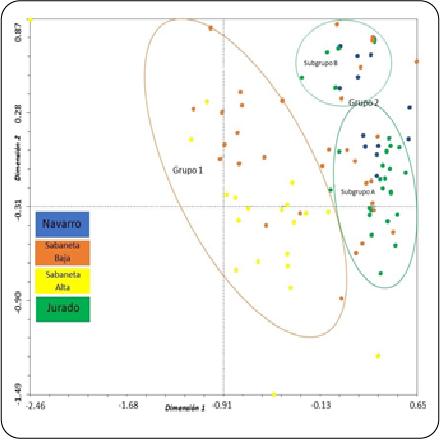
In Colombia, the area of R. glaucus Benth cultivation has increased since 2000, as it has organoleptic and economic characteristics of great attractiveness for national and international trade. The improvement of the supply of this product in the country, in a context of climate change, will depend on the implementation of new propagation techniques by farmers and the use of superior genotypes, with high diversity and free of pathogens. In this work, 7 polymorphic Simple Sequence Repeats (SSR) were selected to characterize the genetic fingerprint diversity in 92 individuals of R. glaucus in 23 farms of Pamplona (northeastern Andes of Colombia). DNA extraction was performed using the Invisorb® Spin plant kit. Microsatellites G01, R47a, R123a, R167h, R228a and R285a were amplified by PCR and revealed in 12% polyacrylamide gel. The DICE similarity index, analysis of molecular variation (AMOVA) and multiple correspondence analysis (MCA) reported that the blackberry population evaluated shows moderate to high genetic diversity (67% due to variation of individuals within farms and 33% between farms). The average values of polymorphic information content PIC = 0.302 and expected heterogeneity He = 0.388 indicate that the SSRs are suitable for future research on this species. This work contributes new data to the knowledge of genetic diversity in cultivars of R. glaucus in Colombia, and a set of microsatellites that provide useful information to implement better strategies for plant propagation of blackberry with the support of farmers in the region.
Downloads
References
D. Potter et al., “Phylogeny and classification of Rosaceae,” in Plant Systematics and Evolution, 2007, vol. 266, no. 1–2. doi: 10.1007/s00606-007-0539-9.
J. Y. Huang and J. M. Hu, “Revision of Rubus (Rosaceae) in Taiwan,” Taiwania, vol. 54, no. 4. 2009. doi: 10.6165/tai.2009.54(4).285.
Instituto de Ciencias Naturales, “Colección - hervario,” 2021. http://www.biovirtual.unal.edu.co/es/colecciones/result/genus/Rubus/plants/
J. Graham and M. Woodhead, “Raspberries and Blackberries: The Genomics of Rubus,” in Genetics and Genomics of Rosaceae, 2009. doi: 10.1007/978-0-387-77491-6_24.
M. Mimura, M. Mishima, M. Lascoux, and T. Yahara, “Range shift and introgression of the rear and leading populations in two ecologically distinct Rubusspecies,” BMC Evolutionary Biology, vol. 14, no. 1, p. 209, 2014, doi: 10.1186/s12862-014-0209-9.
Y. Wang et al., “Phylogenetic insight into subgenera Idaeobatus and Malachobatus (Rubus, Rosaceae) inferring from ISH analysis,” Molecular Cytogenetics, vol. 8, no. 1, 2015, doi: 10.1186/s13039-015-0114-y.
Q. Chen, Y. Wang, H. Nan, L. Zhang, H. Tang, and X. Wang, “Meiotic configuration and rDNA distribution patterns in Six Rubus taxa,” Indian Journal of Genetics and Plant Breeding, vol. 75, no. 2, 2015, doi: 10.5958/0975-6906.2015.00037.1.
K. Armes Carter, “Phylogenetic Estimation and Ancestral State Reconstruction of Rubus (Rosaceae) using Target Capture Sequencing,” Oregon State University, 2018.
A. M. López Gutiérez, M. L. Marulanda Ángel, L. M. Gómez López, and C. F. Barrera Sánchez, “Rubus glaucus Benth.: Morphology and floral biology aimed at plant breeding processes,” Revista Facultad Nacional de Agronomia Medellin, vol. 72, no. 3, 2019, doi: 10.15446/rfnam.v72n1.75910.
G. Franco and M. J. Giraldo, “El cultivo de la mora.” p. 83, 2001.
R. Orozco-Rodríguez, D. Flores-Mora, y F. Argüello-Delgado, “Efecto de diferentes tipos de propagación en el rendimiento de mora vino (Rubus adenotrichus)”,Agronomía Mesoamericana, vol. 22. Scielo, pp. 91–97, 2011.
G. O. Cancino-Escalante, E. Q. García, C. E. Villamizar, y C. D. Carvajal, “Propagación in vitro de materiales seleccionados de Rubus glaucus Benth (mora de Castilla) en la provincia de Pamplona, región nororiental de Colombia”, Revista Colombiana de Biotecnología, vol. 17, no. 2, pp. 7–15, 2015, doi: 10.15446/rev.colomb.biote.v17n2.54262.
J. Restrepo y R. Sánchez, “Manejo fitosanitario del cultivo de la mora (Rubus glaucus Benth) Medidas para la temporada invernal”, Instituto Colombiano Agropeciario (ICA), 2011, [Online]. Available: chrome-extension://efaidnbmnnnibpcajpcglclefindmkaj/viewer.html?pdfurl=https%3A%2F%2Fwww.ica.gov.co%2Fgetattachment%2Fb7e061eb-ebd3-4f80-9518-c771712405eb%2F-nbsp3bmanejo-fitosanitario-delcultivo-de-la-mora.aspx&clen=1110918&chunk=true
D. F. Marmolejo Cortes, “Evaluación de apomixis en germoplasma seleccionado de mora de Castilla Rubus glaucus Benth,” 2010. [Online]. Available: https://repositorio.unal.edu.co/handle/unal/7343
K. Antonius yH. Nybom, “Discrimination between sexual recombination and apomixes automixis in a Rubus Plant Breeding Programme”, Hereditas, vol. 123, no. 3, 1995, doi: 10.1111/j.1601-5223.1995.00205.x.
K. Antonius-Klemola, “Molecular markers in Rubus(Rosaceae) research and breeding”, The Journal of Horticultural Science and Biotechnology, vol. 74, no. 2, pp. 149–160, Jan. 1999, doi: 10.1080/14620316.1999.11511088.
T. M. Foster, N. V Bassil, M. Dossett, M.Leigh Worthington, yJ. Graham, “Genetic and genomic resources for Rubusbreeding: a roadmap for the future”, Horticulture Research, vol. 6, no. 1, p. 116, 2019, doi: 10.1038/s41438-019-0199-2.
D. Charlesworth, “Evolution of plant breeding systems”, Current Biology, vol. 16, no. 17, pp. R726–R735, 2006, doi: https://doi.org/10.1016/j.cub.2006.07.068.
S. Swarup, E. J. Cargill, K. Crosby, L. Flagel, J. Kniskern, y K. C. Glenn, “Genetic diversity is indispensable for plant breeding to improve crops”,Crop Science, vol. 61, no. 2. 2021. doi: 10.1002/csc2.20377.
Y. Xu, Molecular Plant Breeding. CABI, 2010.
Y.-B. Fu, “Understanding crop genetic diversity under modern plant breeding”, Theoretical and Applied Genetics, vol. 128, no. 11, pp. 2131–2142, 2015, doi: 10.1007/s00122-015-2585-y.
M. A. Nadeem et al., “DNA molecular markers in plant breeding: current status and recent advancements in genomic selection and genome editing”, Biotechnology & Biotechnological Equipment, vol. 32, no. 2, pp. 261–285, Mar. 2018, doi: 10.1080/13102818.2017.1400401.
J. Graham, K. Smith, M. Woodhead, yJ. Russell, “Development and use of simple sequence repeat SSR markers in Rubusspecies”,Molecular Ecology Notes, vol. 2, no. 3. 2002. doi: 10.1046/j.1471-8286.2002.00203.x.
J. Graham, K. Smith, K. MacKenzie, L. Jorgenson, C. Hackett, yW. Powell, “The construction of a genetic linkage map of red raspberry (Rubus idaeussubsp. idaeus) based on AFLPs, genomic-SSR and EST-SSR markers”, Theoretical and Applied Genetics, vol. 109, no. 4, 2004, doi: 10.1007/s00122-004-1687-8.
M. L. Cusba, “Contribución al estudio de la huella genomica de genotipos élite de mora (Rubus glaucusBenth.) mediante marcadores SSRs.,” Universidad pedagógica y tecnológica de Colombia, 2011.
M. L. Marulanda, A. M. López, y M. Uribe, “Genetic diversity and transferability of Rubus microsatellite markers to South American Rubus Species”, The Molecular Basis of Plant Genetic Diversity, 2012. doi: 10.5772/32838.
M. L. Marulanda, A. M. López, y M. Uribe, “Molecular characterization of the Andean blackberry, Rubus glaucus, using SSR markers.”, Genetics and molecular research: GMR, vol. 11, no. 1, pp. 322–331, 2012, doi: 10.4238/2012.February.10.3.
N. R. Castillo, N. V. Bassil, S. Wada, y B. M. Reed, “Genetic stability of cryopreserved shoot tips of Rubus germplasm”,In Vitro Cellular & Developmental Biology -Plant, vol. 46, no. 3, pp. 246–256, 2010, doi: 10.1007/s11627-009-9265-z.
N. R. Castillo, B. M. Reed, J. Graham, F. Fernández-Fernández, yN. V. Bassil, “Microsatellite markers for raspberry and blackberry”, Journal of the American Society for Horticultural Science, vol. 135, no. 3, pp. 271–278, May 2010.
G. O. Cancino-Escalante, L. R. Sánchez-Montaño, E. Quevedo-García, y C. Díaz-Carvajal, “Caracterización fenotípica de accesiones de especies de Rubus L. de los municipios de Pamplona y Chitagá, región Nororiental de Colombia”, Universitas Scientiarum, vol. 16, no. 3, pp. 219–233, Nov. 2011.
G. O. Cancino-Escalante, D. S. Barbosa Hernández, y C. D. Carvajal, “Diversidad genética de especies silvestres y cultivadas de Rubus L. de los municipios de Pamplona y Chitagá, región nororiental de Colombia.”,Bistua: Revista de la Facultad de Ciencias Básicas, vol. 10, no. 1, 2012, doi: 10.24054/01204211.v1.n1.2012.51.
D. A. Hernández-Contreras, F. de Jesús Torres-Torres, M. Figueroa-Lozano, L. R. Sánchez-Montaño, A. M. Posso-Terranova, y J. E. Muñoz-Flórez, “Genetic structure and diversity of Calycolpus moritzianus(Myrtaceae) in the north-eastern Andes of Colombia”,Revista Mexicana de Biodiversidad, vol. 92, 2021, doi: 10.22201/IB.20078706E.2021.92.3635.
B. Pipan, M. Zupancic, E. Blatnik, P. Dolnicar, and V. Meglic, “Comparison of six genomic DNA extraction methods for molecular downstream applications of apple tree (Malus X domestica)”,Cogent Food & Agriculture, vol. 4, no. 1, 2018, doi: 10.1080/23311932.2018.1540094.
C. A. Schneider, W. S. Rasband, y K. W. Eliceiri, “NIH Image to ImageJ: 25 years of image analysis”, Nature Methods, vol. 9, no. 7. 2012. doi: 10.1038/nmeth.2089.
A. L. Zilli, “Ampliación de la base genética del germoplasma tetraploide sexual de Paspalum notatum: caracterización genética y reproductiva de una población sintética”, Universidad Nacional de Rosario, 2017.
F. J. Rohlf, Inc. Applied Biostatistics, y E. S. (Firm), “NTSYS-pc: numerical taxonomy and multivariate analysis system.”,AppliedBiostatistics, Inc.: Exeter Software, Setauket, N.Y., 2009.
M. Nei, “Estimation of average heterozygosity and genetic distance from a small number of individuals”, Genetics, vol. 89, no. 3, 1978, doi: 10.1093/genetics/89.3.583.
R. Peakall y P. E. Smouse, “GenAlEx 6.5: genetic analysis in Excel. Population genetic software for teaching and researchan update.”, Bioinformatics (Oxford, England), vol. 28, no. 19, pp. 2537–2539, Oct. 2012, doi: 10.1093/bioinformatics/bts460.
K. Liu y S. V. Muse, “Power Maker: an integrated analysis environment for genetic maker analysis”, Bioinformatics, vol. 21, no. 9, 2005, doi: 10.1093/bioinformatics/bti282.
D. Botstein, R. L. White, M. Skolnick, y R. W. Davis, “Construction of a genetic linkage map in man using restriction fragment length polymorphisms”, American Journal of Human Genetics, vol. 32, no. 3. 1980. doi: 10.17348/era.9.0.151-162.
J. de Riek, E. Calsyn, I. Everaert, E. van Bockstaele, y M. de Loose, “AFLP based alternatives for the assessment of distinctness, uniformity and stability of sugar beet varieties”, Theoretical and Applied Genetics, vol. 103, no. 8, 2001, doi: 10.1007/s001220100710.
M. Nei, “Analysis of gene diversity in subdivided populations”, Proceedings of the National Academy of Sciences of the United States of America, vol. 70, no. 12 (I), 1973, doi: 10.1073/pnas.70.12.3321.
M. L. Marulanda y A. M. Lopez, “Characterization of thorn less Rubus glaucusin Colombia”, Canadian Journal of Pure & Applied Sciences, vol. 3, no. 3, 2009.
D. Fu et al., “Phylogenetic relationships among five species of Armeniaca Scop. (Rosaceae) using microsatellites (SSRs) and capillary electrophoresis”, Journal of Forestry Research, vol. 27, no. 5, 2016, doi: 10.1007/s11676-016-0245-y.
R. Ouni et al., “Genetic diversity and structure of tunisian local pear germplasm as revealed by SSR markers”, Horticultural Plant Journal, vol. 6, no. 2, pp. 61–70, 2020, doi: https://doi.org/10.1016/j.hpj.2020.03.003.
A. M. López, C. F. Barrera, y M. L. Marulanda, “Evaluation of SSR and SNP markers in Rubus glaucus benth progenitors selection”,Revista Brasileira de Fruticultura, vol. 41, no. 1, 2019, doi: 10.1590/0100-29452019081.
A. C. Morillo, Y. Morillo, J. E. Muñoz F., H. D. Vásquez A., y A. Zamorano, “Caracterización molecular con microsatélites aleatorios RAMs de la colección de mora, Rubusspp. de la Universidad Nacional de Colombia Sede Palmira”, Acta Agronómica, vol. 54, no. 2, 2005.
M. Y. Dotor Robayo, L. A. González-Mendoza, M. A. Castro, A. C. Morillo Coronado, y Y. Morillo Coronado, “Análisis de la diversidad genética de la mora (Rubusspp.) en el departamento de Boyacá”,Biotecnología en el Sector Agropecuario y Agroindustrial, vol. 14, no. 2, 2016, doi: 10.18684/bsaa(14)10-17.
P. Viteri D. et al., “Métodos de propagación y establecimiento del cultivo de mora”, Quito, EC: INIAP, Estación Experimental Santa Catalina, Programa Nacional de Fruticultura, p. cap. 4, pp. 61–76, 2016.
S. C. Debnath y U. Arigundam, “In VitroPropagation Strategies of Medicinally Important Berry Crop, Lingonberry (Vaccinium vitis-idaeaL.)”, Agronomy, vol. 10, no. 5. 2020. doi: 10.3390/agronomy10050744.
A. M. Henao-Ramírez y A. I. Urrea-Trujillo, “Somatic embryogenesis for clonal propagation and associated molecular studies in cacao (Theobroma cacaoL.) BT -Agricultural, Forestry and Bioindustry Biotechnology and Biodiscovery”,P. A. Chong, D. J. Newman, and D. A. Steinmacher, Eds. Cham: Springer International Publishing, 2020, pp. 63–102. doi: 10.1007/978-3-030-51358-0_5.
P. Sivakumar y M. Visalakshi, “In vitromicropropagation of banana cv. Poovan (AAB)”,Journal of Applied Horticulture, vol. 23, no. 1. 2021. doi: 10.37855/jah.2021.v23i01.07.
N. P. Louwaars, “Plant breeding and diversity: a troubled relationship?”,Euphytica, vol. 214, no. 7, p. 114, 2018, doi: 10.1007/s10681-018-2192-5.
C. C. C. Cardona, Y. M. Coronado, A. C. M. Coronado, yI. Ochoa, “Genetic diversity in oil palm (Elaeis guineensisjacq) using RAM (random amplified microsatellites)”,Bragantia, vol. 77, no. 4, 2018, doi: 10.1590/1678-4499.2017385.
M. S. Andersson, R. Schultze-Kraft, M. Peters, M. C. Duque, y G. Gallego, “Extent and structure of genetic diversity in a collection of the tropical multipurpose shrub legume Cratylia argentea (Desv.) O. Kuntze as revealed by RAPD markers”, Electronic Journal of Biotechnology, vol. 10. scielocl, pp. 386–399, 2007. doi: 10.4067/S0717-34582007000300006.
S. G. Khoei, B. A. Mandoulakani, yI. Bernousi, “Genetic diversity in Iranian melon populations and hybrids assessed by IRAP and REMAP markers”, Journal of Agricultural Science and Technology, vol. 17, no. 5, 2015.
D. Kumar et al., “Characterization of genetic diversity and population structure in wheat using array based SNP markers”, Molecular Biology Reports, vol. 47, no. 1, pp. 293–306, 2020, doi: 10.1007/s11033-019-05132-8.
M. L. Marulanda, A. M. López, y S. B. Aguilar, “Genetic diversity of wild and cultivated Rubus species in Colombia using AFLP and SSR markers”, Crop Breeding and Applied Biotechnology, vol. 7, no. 3, 2007, doi: 10.12702/1984-7033.v07n03a03.
T. Getahun et al., “Molecular genetic diversity and population structure in Ethiopian chickpea germplasm accessions”,Diversity, vol. 13, no. 6. 2021. doi: 10.3390/d13060247.
A. C. M. Coronado, Y. P. Tovar-León, y Y. M. Coronado, “Characterization of lulo (Solanum quitoenseLam.) genetic diversity in the department of Boyaca, Colombia”, Acta Agronomica, vol. 66, no. 3, 2017, doi: 10.15446/acag.v66n3.58997.
H. Nybom, “Comparison of different nuclear DNA markers for estimating intraspecific genetic diversity in plants”, Molecular Ecology, vol. 13, no. 5, 2004, doi: 10.1111/j.1365-294X.2004.02141.x.
Y. V. Chesnokov y A. M. Artemyeva, “Evaluation of the measure of polymorphism information of genetic diversity”, Sel’skokhozyaistvennaya Biologiya, vol. 50, no. 5, 2015, doi: 10.15389/agrobiology.2015.5.571eng.
D. González-Cerritos, C. A. Núñez-Colín, E. Villordo-Pineda, G. Medina-Ramos, y M. M. González-Chavira, “Variabilidad genética del membrillo cimarrón (Malacomeles denticulata[Kunth] Jones) obtenida mediante marcadores Inter Secuencias Simples Repetidas o Intermicro satélites (ISSR)”,Acta Universitaria, vol. 25, no. 4, 2015, doi: 10.15174/au.2015.773.
C. Cekic, O. Calis, y S. Ozturk Erdem, “Genetic diversity of wild raspberry genotypes (Rubus idaeusL.) in North Anatolia based on issr markers”,Applied Ecology and Environmental Research, vol. 16, no. 5, 2018, doi: 10.15666/aeer/1605_68356843.
E. Sedighi yM. Rahimmalek, “Evaluation of genetic diversity of Rubus hyrcanususing Inter Simple Sequence Repeat (ISSR) and morphological markers”,Biologia (Poland), vol. 70, no. 3, 2015, doi: 10.1515/biolog-2015-0039.
Downloads
Published
Issue
Section
License
Copyright (c) 2021 Daniel Augusto Araque Castellanos, Giovanni Orlando Cancino Escalante, Diego Alexander Hernández Contreras, Danny Chinchilla Cárdenas

This work is licensed under a Creative Commons Attribution-NonCommercial-NoDerivatives 4.0 International License.