Evolución Química y Biotecnológica de Moléculas con Actividad de Tipo Auxina: Una Revisión
DOI:
https://doi.org/10.24054/bistua.v20i1.1214Palabras clave:
Auxina, Regulador del Crecimiento Vegetal, Herbicida Sintético tipo AuxinaResumen
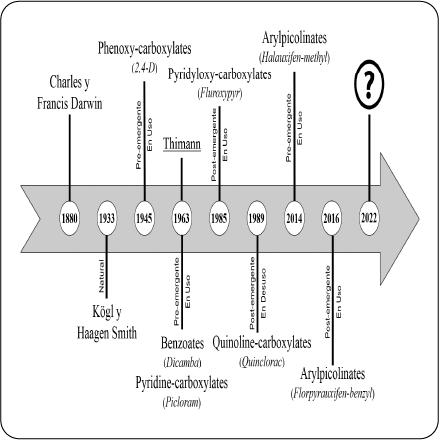
Según valoraciones demográficas, se requiere aumentar un 70% la productividad agrícola para poder alimentar 9.000 millones de personas adicionales en el año 2050, aun cuando factores bióticos-abióticos dificultan dicho propósito. Con el objetivo de impulsar el desarrollo de nuevos herbicidas, esta revisión sistemática de compilación analizó la evolución química y biotecnológica de moléculas con actividad de tipo auxina. Para ello, se buscó información científica sobre descriptores físico-químicos de auxinas, clasificación agroquímica y usos según el sitio de acción, a fin de describir los cambios acaecidos desde su descubrimiento hasta nuestros días. El análisis crítico químico reveló que la síntesis industrial e innovación en los últimos 70 años ha sido escasa, y adicionalmente, los compuestos comercializados no siguen un patrón farmacofórico definido por carecer de homología estructural con el IAA. Es menester comprender desde un enfoque genómico la bioquímica ligando-receptor y los mecanismos transportadores asociados, para dirigir con herramientas computacionales la síntesis racional de moléculas que evadan mecanismos de resistencia. El análisis biotecnológico mostró que la industrialización de la agricultura y la aparición de plantas transgénicas forzó la incorporación de herbicidas tipo auxina para eliminar malezas y mejorar el rendimiento de cultivos, aunque su mala utilización provocó resistencia y contaminación ambiental, lo que está llevándolos al desuso y posesionando los PGPR y PGPB como alternativas funcionales a nivel de laboratorio y pequeña escala. Finalmente, se concluye que el problema de resistencia a herbicidas no podrá ser subsanado hasta que se articule el trinomio agricultor-gobierno-academia.
Descargas
Referencias
Yendrek, C., Tomaz, T., Montes, C., Cao, Y., Morse, A., Brown, P. McIntyre, L., Leakey, A., Ainsworth, E. (2017). High-Throughput phenotyping of maize leaf physiological and biochemical traits using hyperspectral reflectance. Plant Physiology 173:614–626. www.plantphysiol.org/cgi/doi/10.1104/pp.16.01447
Yilmaz, R. (2019). Modern biotechnology breakthroughs to food and agricultural research in developing countries. GM Crops & Food. 10:12–16. DOI: 10.1080/21645698.2019.1600969
Ali, S., Baek, K. (2020). Jasmonic acid signaling pathway in response to abiotic stresses in plants. Int. J. Mol. Sci. 21:621. Doi:10.3390/ijms21020621
Harfouche, A., Petousi, V., Meilan, R., Sweet, J., Twardowski, T., Altman, A. (2021). Promoting ethically responsible use of agricultural biotechnology. Trends in Plant Science 26(6). https://doi.org/10.1016/j.tplants.2020.12.015
Ciura, J., Kruk, J. (2018). Phytohormones as targets for improving plant productivity and stress tolerance. Journal of Plant Physiology 229: 32–40. https://doi.org/10.1016/j.jplph.2018.06.013
Dahabieh, M., Bröring, S., Maine, E. (2018). Overcoming barriers to innovation in food and agricultural biotechnology. Trends in Food Science & Technology 79: 204–213. https://doi.org/10.1016/j.tifs.2018.07.004
Khan, N., Bano, A., Rahman, M., Guo, J., Kang, Z., Babar, A. (2019). Comparative physiological and metabolic analysis reveals a complex mechanism involved in drought tolerance in chickpea (Cicer arietinum L.) induced by PGPR and PGRS. Scientific Reports 9:2097. https://doi.org/10.1038/s41598-019-38702-8
Wani, S., Kumar, V., Shiram, V., Sah, S. (2016). Phytohormones and their metabolic engineering for abiotic stress tolerance in crop plants. The Crop Journal 4:162–176. http://dx.doi.org/10.1016/j.cj.2016.01.010
Zhen, Y., Ji-Yun, N., Yang, C., Zhi-Xia, L., Guo-Feng, X., Hai-Fei, L. (2017). Simultaneous determination of plant growth regulators in fruit by Ultra-Performance Liquid Chromatography-Tandem Mass Spectrometry coupled with modified quechers procedure. Chin J Anal Chem 45(5):e1719–e1725. DOI: 10.1016/S1872-2040(17)61015-6
Todd, O., Figueiredo, M., Morran, S., Soni, N., Preston, C., Kubeš, M., Napier, R., Gaines, T. (2020). Synthetic auxin herbicides: finding the lock and key to weed resistance. Plant Science 300: 110631. https://doi.org/10.1016/j.plantsci.2020.110631
Kaundun, S. (2020). Syngenta's contribution to herbicide resistance research and management. Pest Manag Sci 77:1564–1571. DOI 10.1002/ps.6072
Quareshy, M., Prusinska, J., Li, J., Napier, R. (2018). A cheminformatics review of auxins as herbicides. Journal of Experimental Botany. doi:10.1093/jxb/erx258
Raparelli, E., Macari, G., Scaglione, M., Bajocco, S., Scarascia, G. (2018). Structural trend and conceptual evolution of research on genetically modified organisms using a science mapping approach. Journal of Cleaner Production 205: 329e338. https://doi.org/10.1016/j.jclepro.2018.09.118
Pardal-Refoyo, J., Pardal-Peláez, B. (2020). Anotaciones para estructurar una revisión sistemática. Rev. ORL 11(2): 155-160. DOI: https://doi.org/10.14201/orl.22882
Pelai, R., Hagerman, S., Kozak, R. (2020). Biotechnologies in agriculture and forestry: Governance insights from a comparative systematic review of barriers and recommendations. Forest Policy and Economics 117: 102191. https://doi.org/10.1016/j.forpol.2020.102191
Yepez-Nuñez, J., Urrútia, G., Romero-García, M., Alonso-Fernández, S. (2021). Declaración PRISMA 2020: una guía actualizada para la publicación de revisiones sistemáticas. Rev Esp Cardiol. 74(9):790–799. https://doi.org/10.1016/j.recesp.2021.06.016
Busi, R., Goggin,Heap, I., Horak, M., Jugulam, M., Masters, R., Napier, R., Riar, D., Satchivi, N., Torra, J., Westrah P., RWrighte, T. ( 2018). Weed resistance to synthetic auxin herbicides. Pest Manag Sci 74(10): 2265–2276. DOI 10.1002/ps.4823
Casanova-Sáez, R., Voß, U. (2019). Auxin metabolism controls developmental decisions in land plants. Trends in Plant Science 24(8). https://doi.org/10.1016/j.tplants.2019.05.006
Kim, M., Seo, H., Park, C., Park, W. (2016). Examination of the auxin hypothesis of phytomelatonin action in classical auxin assay systems in maize. Journal of Plant Physiology 190:67–71. http://dx.doi.org/10.1016/j.jplph.2015.11.009
Gaines, T. (2020). The quick and the dead: a new model for the essential role of ABA accumulation in synthetic auxin herbicide mode of action. Journal of Experimental Botany 71(12): 3383–3385. doi:10.1093/jxb/eraa178
Porfirio, S., Gomes da Silva, M., Peixe, A., Cabrita, M., Azadi, P. (2016). Current analytical methods for plant auxin quantification –A review.Analytica Chimica Acta 902:8–21. http://dx.doi.org/10.1016/j.aca.2015.10.035
Rodriguez-Furlán, C., Miranda, G., Reggiardo, M., Hicks, G., Norambuena, L. (2016). High throughput selection of novel plant growth regulators: Assessingthe translatability of small bioactive molecules from Arabidopsis to crops. Plant Science 245:50–60. http://dx.doi.org/10.1016/j.plantsci.2016.01.001
Vela, A. (2016). Logros y perspectivas de la Química Teórica. Educación Química 27:278---285. http://dx.doi.org/10.1016/j.eq.2016.09.001
Lace, B., Prandi, C. (2016). Shaping small bioactive molecules to untangle their biological function: A focus on fluorescent plant hormones. Molecular Plant 9, 1099–1118. http://dx.doi.org/10.1016/j.molp.2016.06.011
Hoyerova, K., Hosek, P., Quareshy,M., Li, J., Klima, P., Kubes, M., Yemm, A., Neve, P., Tripathi, A., Bennett, M., Napier, R. (2017). Auxin molecular field maps define AUX1 selectivity: many auxin herbicides are not substrates. New Phytologist. Doi: 10.1111/nph.14950
Thimann, K. (1963). Plant growth substances; past, present and future. Annu. Rev. Plant. Physiol. 14:1-19
Ferro, N., Bredow, T., Jacobsen, H., Reinard, T. (2010). Route to novel Auxin: Auxin chemical space toward biological correlation carriers. Chemical Reviews110(8): 4690–4708.
Cao, X., Yang, H., Shang, C., Ma, S., Liu, L., Cheng, J. (2019). The roles of auxin biosynthesis YUCCA gene family in plants. Int. J. Mol. Sci. 20: 6343. doi:10.3390/ijms20246343
Ma, Q., Grones, P., Robert, S. (2018). Auxin signaling: abig question to be addressed by small molecules. Journal of Experimental Botany 69(2): 313–328. doi:10.1093/jxb/erx375176. http://dx.doi.org/10.1016/j.cj.2016.01.010
Weijers, D., Nemhauser, J., Yang, Z. (2018). Auxin: small molecule, big impact. Special Issue Editorial. Journal of Experimental Botany
Bushkov, N., Veselov, M., Chuprov-Netochin, R., Marusich, E., Majouga, A., Volynchuk, P., Shumilina, D., Leonov, S., Ivanenkov, Y. (2016). Computational insight into the chemical space of plant growth regulators. Phytochemistry 122:254–264. http://dx.doi.org/10.1016/j.phytochem.2015.12.006
Epp, J., Alexander, A., Balko, T., Buysse, A., Brewster, W., Bryan, K., Daeuble, J., Fields, C., Gast, R., Green, R., Irvine, N., Lo, W., Lowe, C., Renga, J., Richburg, J., Ruiz, J., Satchivi, N., Schmitzer, P., Siddall, L., Webster, J., Weimer, M., Whiteker, G., Yerkes, C. (2016). The discovery of ArylexTM active and RinskorTM active: Two novel auxin herbicides. Bioorganic & Medicinal Chemistry 24: 362–371. http://dx.doi.org/10.1016/j.bmc.2015.08.011
Moss, S., Ulber, L., Hoed, I. (2019). A herbicide resistance risk matrix. Crop Protection 115: 13–19. https://doi.org/10.1016/j.cropro.2018.09.005
Rzemieniecki, T., Wojcieszak, M., Materna, K., Praczyk, T., Pernak, J. (2021). Synthetic auxin-based double salt ionic liquids as herbicides with improved physicochemical properties and biological activity. Journal of Molecular Liquids 334: 116452. https://doi.org/10.1016/j.molliq.2021.116452
Nakka, S., Jugulam, M., Peterson, D., Asif, M. (2019). Herbicide resistance: Development of wheat production systems and current status of resistant weeds in wheat cropping systems. The Crop Journal 7: 750 –760. https://doi.org/10.1016/j.cj.2019.09.004
Beckie, H., Ashworth, M., Flower, K. (2019). Herbicide resistance management: Recent developments and trends. Plants 8: 161. Doi: 10.3390/plants8060161
Gaines, T., Duke, S., Morran, S., Rigon, C., Tranel, P., Küpper, A., Dayan, F. (2020). Mechanisms of evolved herbicide resistance. J. Biol. Chem. 295(30): 10307–10330. Doi: 10.1074/jbc.REV120.013572
Das, S., Weijers, D., Borst, J. (2021). Auxin response by the numbers. Trends in Plant Science 26 (5). https://doi.org/10.1016/j.tplants.2020.12.017
Muniz, D., Garcia, J., Braga, T., Fátima, A., Modolo, L. (2019). Pre-emergence application of (thio)urea analogues compromises the development of the weed species Bidens pilosa, Urochloa brizantha, and Urochloa decumbens. Journal of Advanced Research 17: 95–102. https://doi.org/10.1016/j.jare.2019.01.017
Cornelissen, M., Malyska, A., Nanda, A., Lankhorst, R., Parry, M., Rodrigues, V., Pribil, M., Nacry, P., Inzé, D., Baekelandt, A. (2021). Biotechnology for tomorrows world: Scenarios to guide directions for future innovation. Trends in Biotechnology 39(5). https://doi.org/10.1016/j.tibtech.2020.09.006
Guo, W., Wang, W., Zhang, W., Li, W., Wang, Y., Zhang, S., Chang, J., Ye, Q., Gan, J. (2021). Mechanisms of the enantioselective effects of phenoxyalkanoic acid herbicides DCPP and MCPP. Science of the Total Environment 788: 147735. https://doi.org/10.1016/j.scitotenv.2021.147735
Montagu, M. (2020). The future of plant biotechnology in a globalized and environmentally endangered world. Genetics and Molecular Biology 43:1(suppl 2), e20190040. DOI: http://dx.doi.org/10.1590/1678-4685-GMB-2019-0040
Morales-Tapia, A., Cruz-Ramírez, A. (2016). Computational modeling of Auxin: A foundation for plant engineering. Front. Plant Sci. 7:1881. doi: 10.3389/fpls.2016.01881
Figueiredo, D., Köhler, C. (2018). Auxin: a molecular trigger of seed development. Genes & Development 32: 479–490. www.genesdev.org/cgi/doi/10.1101/gad.312546.118
Gouda, S., Kerry., R., Das, S., Paramithiotis, S., Shin, H., Patra, J. (2018). Revitalization of plant growth promoting rhizobacteria for sustainable development in agricultura. Microbiological Research 206: 131–140. http://dx.doi.org/10.1016/j.micres.2017.08.016
Rischer, H., Szilvay, G., Oksman-Caldentey, K. (2020). Cellular agriculture —industrial biotechnology for food and materials. Current Opinion in Biotechnology 61:128–134. https://doi.org/10.1016/j.copbio.2019.12.003
Francis, D., Finer, J., Grotewold, E. (2017). Challenges and opportunities for improving food quality and nutrition through plant biotechnology. Current Opinion in Biotechnology 44:124–129. http://dx.doi.org/10.1016/j.copbio.2016.11.009
Tyczewska, A., Wozniak, E., Gracz, J., Kuczynski, J., Twardowski, T. (2018). Towards food security: current state and future prospects of agrobiotechnology. Trends in Biotechnology 36(12). https://doi.org/10.1016/j.tibtech.2018.07.008
Nejat, N., Mantri, N. (2017). Plant immune system: crosstalk between responses to biotic and abiotic stresses the missing link in understanding plant defence. Curr. Issues Mol. Biol. 23: 1-16. DOI: http://dx.doi.org/10.21775/cimb.023.001
Numan, M., Bashir, S., Khan, Y., Mumtaz, R., Shinwari, Z., Khan, A. L., Khan, A., AL-Harrasi, A. (2018). Plant growth promoting bacteria as an alternative strategy for salt tolerance in plants: A review. Microbiological Research 209: 21–32. https://doi.org/10.1016/j.micres.2018.02.003
Leontidou, K., Genitsaris, S., Papadopoulou, A., Kamou, N., Bosmali, I., Matsi, T., Madesis, P., Vokou, D., Karamanoli, K., Mellidou, I. (2020). Plant growth promoting rhizobacteria isolated from halophytes and drought tolerant plants: genomic characterisation and exploration of phyto beneficial traits. Scientific Reports. 10: 14857. https://doi.org/10.1038/s41598-020-71652-0
Tian, H., Lv, B., Ding, T., Bai, M., Ding, Z. (2018). Auxin-BR interaction regulates plant growth and development. Front. Plant Sci. 8:2256. doi: 10.3389/fpls.2017.02256
Cerný, M., Novák, J., Habánová, H., Cerna, H., Brzobohatý, B. (2016). Role of the proteome in phytohormonal signaling. Biochimica et Biophysica Acta 1864: 1003–1015. http://dx.doi.org/10.1016/j.bbapap.2015.12.008
Small, C., Degenhardt, D. (2018). Plant growth regulators for enhancing revegetation success in reclamation: A review. Ecological Engineering 118: 43–51. https://doi.org/10.1016/j.ecoleng.2018.04.010
Alcantara, J., Acero, J., Alcántara, J.D., Sánchez, R. (2019). Principales reguladores hormonales y sus interacciones en el crecimiento vegetal. NOVA 17 (32): 109-129
Qin, H., Huang, R. (2018). Auxin controlled by ethylene steers root development. Int. J. Mol. Sci. 19: 3656. doi:10.3390/ijms19113656
Brumos, J., Robles, L., Yun, J., Vu, T., Jackson, S., Alonso, J., Stepanova, A. (2018). Local auxin biosynthesis is a key regulator of plant development. Developmental Cell 47: 306–318. https://doi.org/10.1016/j.devcel.2018.09.022
Mateo-Bonmatí, E., Casanova-Sáez, R., Ljung, K. (2019). Epigenetic regulation of auxin homeostasis. Biomolecules 9: 623. doi:10.3390/biom9100623
Chen, H., Qin, Y., Pu, J., Hu, J., Wen, Y. (2021). Phytotoxicity of the chiral herbicide dichlorprop: Cross-talk between nitric oxide, reactive oxygen species and phytohormones. Science of the Total Environment 788: 147866. https://doi.org/10.1016/j.scitotenv.2021.147866
Fan, C., Yang, J., Liang, Y., Dong, H., Zhang, W., Tang, G., Cao, Y. (2019). Effective tuning guanidinium ionic liquid as greener solvent for fast and sensitive determination of auxin herbicides. Microchemical Journal 144: 73–82. https://doi.org/10.1016/j.microc.2018.08.054
Goggin, D., Kaur, P., Owen, M., Powles, S. (2018). 2,4-D and dicamba resistance mechanisms in wild radish: subtle, complex and population specific? Annals of Botany 122: 627–640. doi: 10.1093/aob/mcy097
Boivin, S., Fonouni-Farde, C., Frugier, F. (2016). How Auxin and Cytokinin phytohormones modulate root microbe interactions. Frontiers in Plant Science. 7: 1240. Doi: 10.3389/fpls.2016.01240
Olanrewaju, O., Glick, B., Babalola, O. (2017). Mechanisms of action of plant growth promoting bacteria. World J Microbiol Biotechnol. 33: 197. DOI 10.1007/s11274-017-2364-9
Ramakrishna, W., Yadav, R., Li, K. (2019). Plant growth promoting bacteria in agriculture: Two sides of a coin. Applied Soil Ecology 138: 10–18. https://doi.org/10.1016/j.apsoil.2019.02.019
Gange, A., Gadhave, K. (2018). Plant growth-promoting rhizobacteria promote plant size inequality. Scientific Reports. 8:13828. DOI: 10.1038/s41598-018-32111-z
Bücker-Neto, L., Sobral, A., Machado, R., Arenhart, R., Margis-Pinheiro, M. (2017). Interactions between plant hormones and heavy metals responses. Genetics and Molecular Biology. DOI: http://dx.doi.org/10.1590/1678-4685-GMB-2016-0087
Nascimento, F., Hernández, A., Glick, B., Rossi, M. (2020). Plant growth-promoting activities and genomic analysis of the stress-resistant Bacillus megaterium STB1, a bacterium of agricultural and biotechnological interest. Biotechnology Reports 25: e00406. https://doi.org/10.1016/j.btre.2019.e00406
Descargas
Publicado
Versiones
- 2022-08-12 (5)
- 2022-04-21 (4)
- 2022-04-21 (3)
- 2022-04-21 (2)
- 2022-04-21 (1)
Número
Sección
Licencia
Derechos de autor 2022 Harriete del Rosario Duran Sandoval, Jorge Eliecer Espitia Baena, Giovanni Orlando Cancino Escalante

Esta obra está bajo una licencia internacional Creative Commons Atribución-NoComercial-SinDerivadas 4.0.