Influence of isometric exercises on YOP CHAGUI technique in teenager athletes
DOI:
https://doi.org/10.24054/afdh.v16i1.4246Keywords:
atleta, ejercicios isométricos, mejoramiento de técnicaAbstract
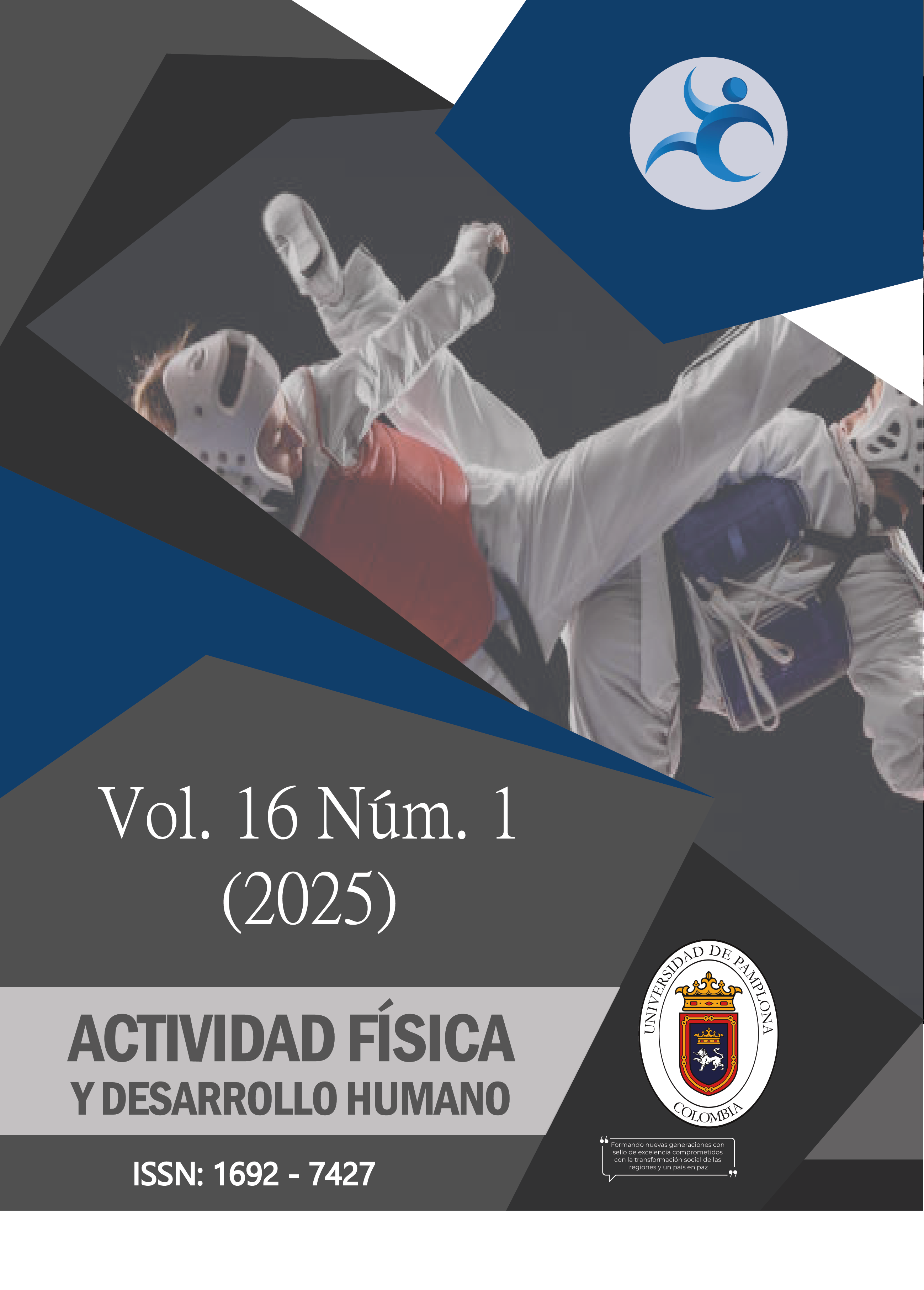
Training the strength and power of the yop chagui kick, especially in the front leg, in taekwondo athletes between 14 & 15 years old, with isometric exercises, aims to improve the execution of this technique in combat, since it is the most used and effective kick in competitions to score points and win competitions in the practice of taekwondo.
This technique, fundamental in taekwondo, requires not only correct execution, but also great power to be effective in combat situations. thus, This study analyzed the influence of isometric exercises on the Yop Chagui technique in 14 and 15-year-old taekwondo athletes. Five athletes were evaluated through strength, stability, and precision tests before and after a training program based on isometric exercises. The results indicated significant improvements in the stability, control, and power of the technique, suggesting that this type of training contributed to sports performance. Additionally, isometric exercises were found to aid in injury prevention and muscle fatigue reduction.
From a methodological point of view, this study focused on the use of technological tools to evaluate key variables in the execution of the yop chagui technique, such as the force generated during the kick and the functioning of the lower and upper body of the body. the use of technology in biomechanical analysis and physical training provides an innovative and more precise approach that allows training programs to be personalized and maximize their effectiveness.
Downloads
References
Antoría, F. (2019). El desarrollo de la fuerza estática en taekwondo: Un enfoque práctico para mejorar la técnica de la patada. Revista de Investigación en Deportes de Combate, 24(1), 57–72.
Caspersen, C. J., Powell, K. E., & Christenson, G. M. (1985). Physical activity, exercise, and physical fitness: Definitions and distinctions. Public Health Reports, 100(2), 126–131.
Cervantes, J. A. (2019). Entrenamiento preventivo de lesiones en jóvenes deportistas. Journal of Sports Science, 18(3), 212–219.
Chavez, R., & González, D. (2018). Entrenamiento isométrico en jóvenes deportistas: Beneficios para la estabilidad y la potencia en deportes de combate. International Journal of Sports Training, 16(4), 218–229.
Choi, H., & Kang, D. (2018). Biomechanics of Taekwondo techniques: Yop Chagui. Journal of Sports Science and Medicine, 17(2), 192–197.
Díaz, M., & Gómez, A. (2018). Desarrollo físico y técnico de adolescentes en deportes de combate. Revista de Psicología Deportiva, 21(1), 56–65.
García, M., & Hernández, J. (2022). El entrenamiento temprano en taekwondo: El impacto en el rendimiento físico y técnico de los jóvenes deportistas. Revista Internacional de Ciencias del Deporte, 20(1), 45–60.
García, M., & Hernández, J. (2022). El entrenamiento temprano en taekwondo: El impacto en el rendimiento físico y técnico de los jóvenes deportistas. Revista Internacional de Ciencias del Deporte, 20(1), 45–60.
Garcia, M., & López, A. (2015). Principios de entrenamiento físico y deportivo. Editorial Médica Panamericana.
González, J., & Martínez, D. (2019). Efectos de los ejercicios isométricos en la fuerza muscular en jóvenes deportistas. Revista Internacional de Ciencias del Deporte, 12(4), 30–38.
González, J., & Pérez, M. (2019). La influencia de los ejercicios isométricos en el rendimiento técnico de los jóvenes en taekwondo. Revista de Ciencias del Ejercicio y la Salud, 19(2), 99–110.
González-Badillo, J. J., & Sánchez-Medina, L. (2010). Fundamentals of isometric training: Effects and applications. Strength and Conditioning Journal, 32(3), 53–61.
Harre, D. (1994). La fuerza como base para el rendimiento deportivo. Editorial Esfinge.
Harre, D. (1994). The development of strength. Human Kinetics Publishers.Influence of resistance training frequency on muscular adaptations in well-trained men. Journal of Strength & Conditioning Research, 26, 1821–1829. doi: 10.1519/JSC.0000000000000970
Hess, J. (2019). Strength training in combat sports: Isometric training for explosive power. Sports Science Review, 25(2), 73–85.
Jung, J., Park, M., & Lee, S. (2021). The role of isometric strength training in taekwondo athletes. Journal of Martial Arts Research, 14(1), 45–53.
Kim, S. H., & Lee, Y. H. (2010). The effect of taekwondo kicking techniques on the stability of core muscles. Journal of Sports Science & Medicine.
Kim, Y., & Park, J. (2021). Biomechanics of taekwondo kicking techniques: A study on Yop Chagui. Journal of Combat Sports Science, 18(1), 55–63.
Lee, H. (2016). Taekwondo: The martial art of Korea. University of California Press.
López, A., & Martínez, D. (2021). La influencia de los ejercicios isométricos en el rendimiento técnico de los jóvenes en taekwondo. Revista de Ciencias del Ejercicio y la Salud, 19(2), 99–110.
López, C., Rodríguez, E., & Herrera, A. (2022). La importancia de la fuerza isométrica en el entrenamiento de taekwondo: Efectos sobre el rendimiento y la prevención de lesiones. Sports Science Review, 18(4), 95–107.
López, C., Rodríguez, E., & Herrera, A. (2022). La importancia de los ejercicios isométricos en el entrenamiento de taekwondo: Efectos sobre el rendimiento y la prevención de lesiones. Sports Science Review, 18(4), 95–107.
Makarov, P., Ivanov, D., & Petrova, T. (2020). Improving the flexibility and strength of martial artists through isometric exercises. Journal of Martial Arts Fitness, 20(4), 159–168.
Martínez, J., Ramírez, A., & Pérez, F. (2021). Desarrollo de la fuerza en jóvenes atletas de taekwondo en Colombia. Revista de Ciencias del Ejercicio, 14(2), 132–148.
McGill, S. M. (2001). Low back disorders: Evidence-based prevention and rehabilitation. Human Kinetics.
Núñez, C., & Torres, J. (2019). Análisis de la técnica Yop Chagui en taekwondo: Mejora de la fuerza y coordinación en la pierna anterior. Journal of Combat Sports Science, 14(2), 142–158.
Ramírez, L., & Gómez, R. (2020). Impacto de la fuerza isométrica en la ejecución de técnicas en taekwondo: Un enfoque de entrenamiento para adolescentes. Journal of Sport Science, 10(3), 220–231.
Rodríguez, M., Gómez, F., & Sánchez, A. (2017). El desarrollo motor en la adolescencia: Implicaciones para el entrenamiento deportivo. Revista de Ciencias del Deporte y Salud, 22(3), 124–133.
Ruiz, D., Sánchez, V., & Castro, L. (2023). Capacidades condicionales en taekwondo: Evaluación y mejora del rendimiento físico. Revista de Actividad Física y Salud, 15(1), 102–119.
Santos, A., Romero, P., & Martínez, R. (2020). Estrategias de entrenamiento isométrico en deportes de combate: Aplicaciones en taekwondo. International Journal of Sports Training and Coaching, 12(2), 140–151.
Seo, H. (2022). Optimizing the technical performance in taekwondo through strength training. Journal of Taekwondo Research, 24(1), 67–74.
Downloads
Published
Issue
Section
License
Copyright (c) 2025 Oscar Luis Muñoz Oviedo

This work is licensed under a Creative Commons Attribution-NonCommercial-NoDerivatives 4.0 International License.