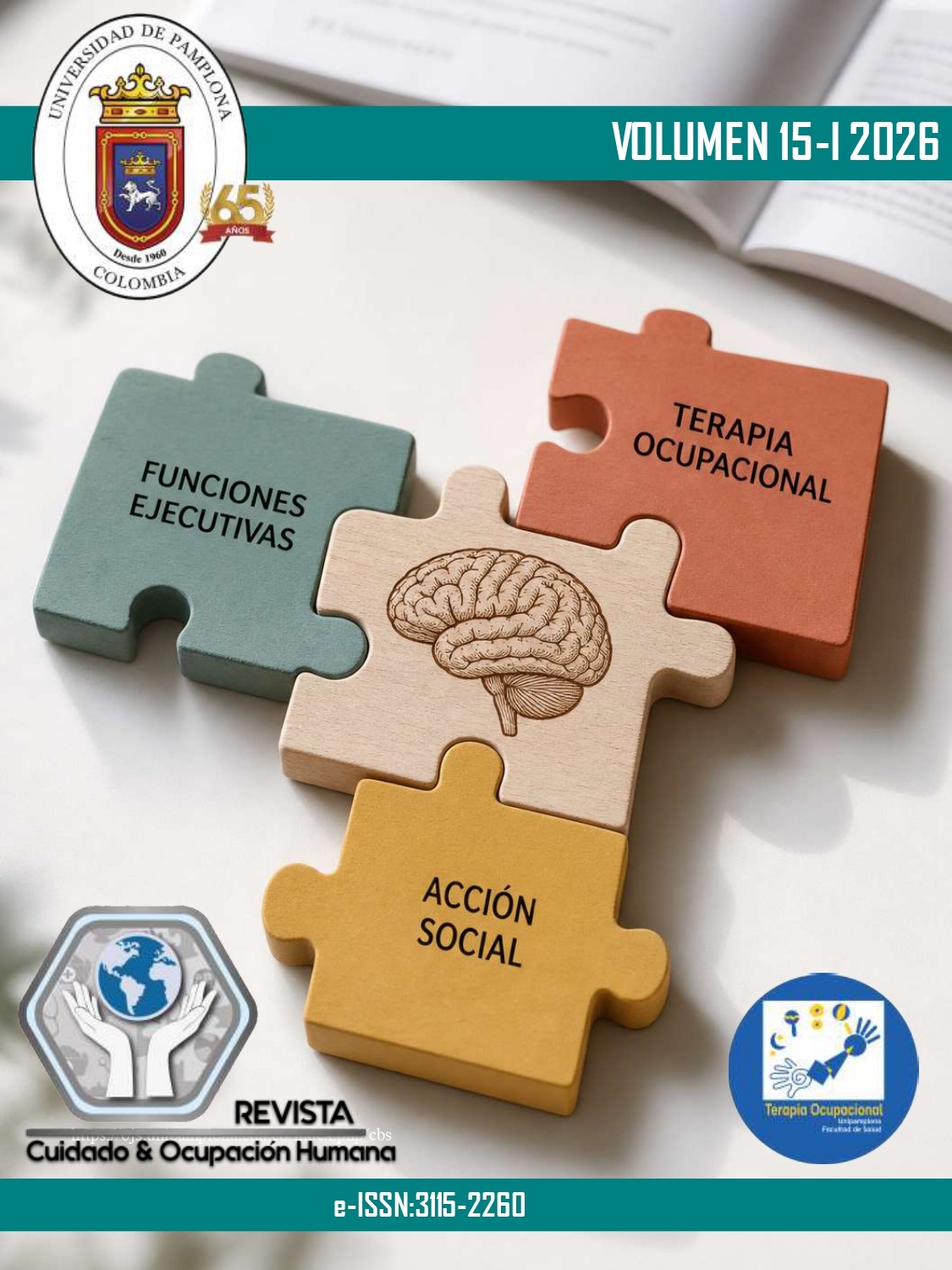
Self-regulation and executive functions in the classroom: evidence-based strategies to prevent learning and behavioral difficulties
DOI:
https://doi.org/10.24054/coh.v15i1.4475Keywords:
Self-regulated learning, executive functions, metacognitive strategies, educational intervention, school performanceAbstract
Learning and behavioral difficulties in the school context represent a significant challenge for teachers and support professionals due to their impact on academic performance, school coexistence, and students’ participation in activities within the educational environment. Numerous studies have indicated that these difficulties are frequently associated with immaturity in self-regulation processes and in the development of executive functions, which are fundamental cognitive skills for planning, inhibitory control, working memory, and cognitive flexibility. The objective of this study was to analyze the relationship between self-regulation, executive functions, and the pedagogical strategies implemented in the classroom to promote learning and students’ behavioral regulation. To achieve this, a qualitative research approach was employed through a documentary review of scientific literature published between 2021 and 2026 in academic databases related to education, psychology, and health sciences. The results indicate that the explicit teaching of metacognitive strategies, teacher guidance, and the implementation of structured models for reflecting on learning processes promote the progressive development of self-regulation. Likewise, strategies such as the NEMO model were identified as contributing to the strengthening of skills related to planning, task organization, and monitoring of academic performance. In conclusion, promoting self-regulation and executive functions in the classroom constitutes a key preventive strategy for improving academic performance, strengthening socio-emotional competencies, and fostering more active and autonomous student participation in the educational process.
Downloads
References
Rodríguez M, et al. Funciones ejecutivas y autorregulación en educación primaria [Internet]. 2023. Disponible en: https://ve.scielo.org/pdf/ric/v6n3/2739-0063-ric-6-03-e603118.pdf
Tirapu-Ustárroz J, Luna-Lario P. Funciones ejecutivas y autorregulación: fundamentos neuropsicológicos. 2021.
Pas P, Johnson S, Larson A, et al. Self-regulation in the pre-adolescent brain. Dev Cogn Neurosci. 2021. Disponible en: https://research-portal.uu.nl/ws/portalfiles/portal/251321055/1-s2.0-S187892932100102X-main.pdf
Parra Bolaños N. Autorregulación emocional y correlatos neuronales en niños y adolescentes [Internet]. 2025. Disponible en: https://dialnet.unirioja.es/descarga/articulo/10142101.pdf
García L, Pérez A. Estimulación de funciones ejecutivas y autorregulación [Internet]. 2023. Disponible en: https://ve.scielo.org/pdf/raiko/v8s2/2542-3088-raiko-8-s2-723.pdf
Ronqui V, Sánchez MF, Trías Seferian D. La enseñanza de la autorregulación en aulas de educación primaria. Cuad Investig Educ. 2021;12(2). Disponible en: https://pmc.ncbi.nlm.nih.gov/articles/PMC11259099/
Hederich-Martínez C, Camargo-Uribe Á, Abello-Camacho D. Relaciones entre las formas de regulación del aprendizaje en el aula. Rev Colomb Educ. 2024;(93):397-413. doi:10.17227/rce.num93-21217. http://www.scielo.org.co/scielo.php?pid=S0120-39162024000400397&script=sci_arttext
Benavides Delgado AC, Serrato Mendoza MP. Procesos de intervención de terapia ocupacional desde la estimulación temprana y la neuroeducación. Excelsium Scientia Rev Int Investig [Internet]. 2024 [citado 19 feb 2026];8(1):53-60. Disponible en: https://revistas.umariana.edu.co/index.php/ExcelsiumScientia/article/view/4113
Fuentes Vilugrón G, et al. Regulación emocional y cultura en contextos escolares. Eur J Educ Psychol. 2023;16(2):1-26. Disponible en: https://revistas.uautonoma.cl/index.php/ejep/article/view/2201
Rizzo-Andrade MO, et al. Estrategias para el aula y desarrollo de la inteligencia emocional. Rev Multidiscip Perspect Investig. 2025;5:1-12. Disponible en: https://doi.org/10.62574/rmpi.v5iEducativa.387
Castro DR, Díaz Carrillo MC, García Martínez EM, Quintero Moya SY. La autorregulación de la labor docente en el aula de clase en una institución educativa en Santander, Colombia. Rev UNIMAR. 2025;43(2):89-103. Disponible en: https://revistas.umariana.edu.co/index.php/unimar/article/download/4494/5139/19671
Rodríguez-Martínez MC, Calvente Barrero E, Romero Ayuso DM. Evaluación de funciones ejecutivas y procesamiento sensorial en el contexto escolar: revisión sistemática. Univ Psychol [Internet]. 2022 [citado 20 feb 2026];20:1-13. Disponible en: https://revistas.javeriana.edu.co/index.php/revPsycho/article/view/30038
Tomaz RF dos S, León CBR. Intervenciones en las funciones ejecutivas durante la niñez temprana: revisión de la literatura. Cad Pós-Grad Distúrb Desenvolv [Internet]. 2021 [citado 20 feb 2026];21(1):9-23. Disponible en: https://pepsic.bvsalud.org/scielo.php?lng=es&pid=S1519-03072021000100002&script=sci_abstract
Barrera Correa AC, Soriano Paredes EA. Efectividad de la intervención multimodal en la optimización de funciones ejecutivas en instituciones educativas. Epistéme Koinonia [Internet]. 2025 [citado 20 feb 2026];7(1):250-74. Disponible en: https://ve.scielo.org/scielo.php?lng=es&nrm=i&pid=S2665-02822025000300250&script=sci_arttext
Valenzuela-Díaz S, Espinoza-Valdéz A, Pino-Gaete T, Ríos-Muñoz Y, Lepe-Martínez N. Intervenciones en funciones ejecutivas para el abordaje de las habilidades socio-comunicativas en estudiantes con TEA: revisión sistemática. CienciAmérica. 2025;14(1):34-52. Disponible en: https://www.cienciamerica.edu.ec/index.php/uti/article/view/491/1022
Bowen-Irish T. Función ejecutiva y su aplicación a la terapia ocupacional en el tratamiento escolar [Internet]. Occupationaltherapy.com. [citado 20 feb 2026]. Disponible en: https://www.occupationaltherapy.com/articles/executive-function-and-its-application-5584
Arias García YS, Cruz Leal GY, García Rodríguez DH, Penagos Romero DM, Romaña Mena Y. Entornos educativos y autorregulación del aprendizaje en contextos vulnerables: un estudio de caso. Cienc Reflexión. 2025;4(3):2083-94. Disponible en: https://cienciayreflexion.org/index.php/Revista/article/view/490
Rivas Mendoza NM, et al. La autorregulación del aprendizaje a través del entorno social desde tres experiencias vividas. Rev Infanc Educ Aprendiz. 2024;10(2):14-22. Disponible en: https://doi.org/10.22370/ieya.2024.10.2.3954
García-Naranjo ML, Grisales-Grisales MC, Quintero-Pamplona DE, Esteban-Duarte N. Evaluación de la eficacia de la autorregulación del aprendizaje en entornos virtuales en educación superior. Cult Educ Soc. 2024;15(2):e34454628. Disponible en: https://revistas.uniminuto.edu/index.php/praxis/article/view/3121/3441
Veugen MJ, Gulikers JTM, Den Brok P. Secondary school teachers’ use of formative assessment practice to create co-regulated learning. J Formative Des Learn. 2024;8:15-32. Disponible en: https://link.springer.com/content/pdf/10.1007/s41686-024-00089-9.pdf
Castro DR, Mena Y, Bueno W, Sarmiento L. La enseñanza de la autorregulación de los docentes de primaria en la Institución Educativa Rural Puerto Claver – Antioquia. 2024. Disponible en: https://estudiosyperspectivas.org/index.php/EstudiosyPerspectivas/article/download/686/1069/3766
Pacha Chipantiza NE, et al. Estrategias para la regulación emocional del docente. Rev Neosapiencia. 2024;2(2):19-35. Disponible en: https://neosapiencia.com/index.php/neosapiencia/article/view/10
Cevallos López K, et al. Impacto de la regulación emocional en el rendimiento académico. Rev Iberoam Educ. 2025;9(4). Disponible en: http://www.revista-iberoamericana.org
Alarcón-Espinoza M, Samper P, Anguera MT. Communication and emotional regulation in the classroom. Ibero-Am J Psychol Public Policy. 2025;2(2):249-86. Disponible en: https://doi.org/10.56754/2810-6598.2025.0037
Martínez C, Rojas P. Manifestaciones de la autorregulación emocional [Internet]. 2022. Disponible en: https://revistasum.umanizales.edu.co/index.php/tempuspsi/article/view/4186
Pinzón Navarro MI, Valero Olaya C, Hernández JM, Becerra Moncada M, Fernández Guayana TG. Prácticas educativas que favorecen la formación en autorregulación del aprendizaje de los estudiantes en Colombia. ACADEMO. 2024;11(3):310-22. Disponible en: https://www.redalyc.org/journal/6882/688278763010/
Downloads
Published
Issue
Section
License
Copyright (c) 2026 Cuidado y Ocupación Humana

This work is licensed under a Creative Commons Attribution-NonCommercial-NoDerivatives 4.0 International License.