Microplastics in continental water sources: impact and mitigation strategies from the perspective of agroindustrial engineering
DOI:
https://doi.org/10.24054/bistua.v22i1.2901Keywords:
Microplastic, Agro-industry, Impact, MitigationAbstract
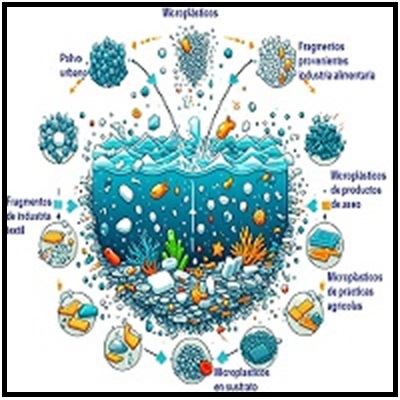
Microplastic research is essential because of their global impact on aquatic ecosystems and human health. Despite the recognition of the problem, there remains a gap in the understanding and mitigation of these pollutants in inland water bodies. This study aims to analyse the state of knowledge on the presence, impact, and mitigation strategies of microplastics from an agro-industrial engineering perspective. A systematic qualitative methodology was employed to review the scientific literature, using specific inclusion criteria in various bibliographic databases, focusing on the search equation microplastic AND freshwater. The results reveal that microplastic pollution is a complex and multifaceted problem, with diverse emission sources affecting aquatic and terrestrial ecosystems. Industrial, agricultural, tourism and domestic activities all contribute to the release of microplastics into the environment. Understanding these sources is essential to develop effective mitigation and removal strategies, such as reducing their generation, recycling existing ones and immobilization to prevent their dispersal. The adoption of sustainable agricultural practices and efficient wastewater treatment systems is crucial in this process. The evaluation of these strategies through mathematical modelling considering the amount and type of microplastics generated, as well as their environmental impact. Successful implementation requires collaboration with farmers and ranchers to promote more sustainable practices. Although examples of implementation are presented, it is important to recognize the limitations and to further research together with relevant stakeholders to find more effective and sustainable solutions.
Downloads
References
Olivatto, GP, Carreira, R., Tornisielo, VL y Montagner, CC (2018). Microplásticos: contaminantes de preocupación mundial en el Antropoceno. Revista Virtual de Química.10(6),1968-1989. 10.21577/1984-6835.20180125
Sharma, S. y Chatterjee, S. (2017). La contaminación por microplásticos, una amenaza para el ecosistema marino y la salud humana: una breve reseña. Investigación sobre ciencias ambientales y contaminación, 24(27), 21530–21547. 10.1007/s11356-017-9910-8
Jambeck, J. R., Geyer, R., Wilcox, C., Siegler, T. R., Perryman, M., Andrady, A., Law, K. L. (2015). Plastic waste inputs from land into the ocean. Science, 347(6223), 768–771. doi:10.1126/science.1260352.
Lebreton, L. C. van der Zwet, J. Damsteeg, J. W. Slat, B. Andrady, A. & Reisser, J. (2017). River plastic emissions to the world's oceans. Nature communications, 8(1), 1-10.
Eriksen, M. Lebreton, L. C. Carson, H. S. Thiel, M. Moore, C. J. Borerro, J. C. & Reisser, J. (2014). Plastic pollution in the world's oceans: more than 5 trillion plastic pieces weighing over 250,000 tons afloat at sea. PLoS One, 9(12), e111913.
Bouwmeester, H., Hollman, PC, Peters, RJ, 2015. Impacto potencial en la salud de los micro y nanoplásticosliberados al medio ambiente en la cadena de producción de alimentos humanos: experiencias de la nanotoxicología. Medio ambiente.Ciencia.Tecnología. 49 (15), 8932–8947. https://doi.org/10. 1021/ acs.est.5b01090.
Su, L. Xue, Y. Li, L. Yang, D. & Kolandhasamy, P. (2016). Microplastic pollution in freshwater ecosystems: a review and proposal of a monitoring and management framework. Environmental Science and Pollution Research, 23(9), 8117-8131.
Duis, K., Coors, A., 2016. Microplásticos en el medio acuático y terrestre:fuentes (con un enfoque específico en productos de cuidado personal), destino y efectos. Reina Ciencia. EUR. 28, 1–25. https://doi.org/10.1186/s12302-015-0069.
Kosuth, M., Mason, SA, Wattenberg, EV, 2018. Contaminación antropogénica del agua del grifo, la cerveza y la sal marina. MÁS UNO 13 (4), e0194970. https://doi.org/10.1371/journal.pone. 0194970.
Browne, MA; Crump, P.; Niven, SJ; Teuten, E.; Tonkín, A.; Galloway, T.; Thompson R., Acumulación de microplásticos en las costas de todo el mundo: fuentes y sumideros. Ambiental Ciencia y Tecnología 2011, 45, 9175-9179.
Boots, B., Russell, CW, Green, DS, 2019. Efectos de los microplásticos en los ecosistemas del suelo: por encima y por debajo del suelo. Reinar. Ciencia. Tecnología. 53, 11496–11506. https://doi.org/10.1021/acs.est.9b03304.
Blasing, M., Amelung, W., 2018. Plásticos en el suelo: métodos analíticos y posibles fuentes. 1605. Microbiol. 9, 819. Ciencia. Medio ambiente total. 612, 422-435.
Kumar, M., Xiong, X., He, M., Tsang, DCW, Gupta, J., Khan, E., Harrad, S., Hou, D., Ok, YS, Bolan, NS, 2020. Microplásticos como contaminantes en suelos agrícolas. Reinar.
Galafassi, S., Nizzetto, L., Volta, P., 2019. Fuentes de plástico: un estudio de la literatura científica y gris sobre su inventario y contribución relativa a la contaminación por microplásticos en entornos naturales, con énfasis en las aguas superficiales. Ciencia. Medio ambiente total. 693, 133499.
Barnes, DK; Galgani, F.; Thompson, RC; Barlaz, M., Acumulación y fragmentación de desechos plásticos en entornos globales. Transacciones filosóficas de la Royal Society de Londres. Serie B, Ciencias Biológicas 2009, 364, 1985-1998.
Guo, J., Huang, X., Xiang, L., Wang, Y., Li, Y., Li, H., Cai, Q., 2020. Fuente, migración y toxicología de microplásticos en el suelo. Reinar. En t. 137, 105263. https://doi.org/10.1016/j.envint.2019.105263.
Lusher, A., Hollman, P., Mendoza-Hill, J., 2017. Microplásticos en la pesca y la acuicultura: estado del conocimiento sobre su aparición e implicaciones para los organismos acuáticos y la seguridad alimentaria. Documento técnico de pesca y acuicultura de la FAO. 615 https://www.fao.org/3/i7677e/i7677e.pdf
Lassen, C.; Hansen, SF; Magnusson, K.; Hartmann, NB; Rehne Jensen, P.; Nielsen, TG; Brinch, A. Presencia de microplásticos, efectos y fuentes de emisiones al medio ambiente en Dinamarca; Agencia Danesa de Protección Ambiental: Copenhague, Dinamarca, 2015.
Barboza, LGA, Vethaak, AD, Lavorante, BRBO, Lundebye, AK, Guilhermino, L., 2018. Desechos microplásticos un problema emergente para la seguridad alimentaria, la inocuidad de los alimentos y la salud humana.
Rochman (2015) titulado"Anthropogenic debris in seafood: Plastic debris and fibers from textiles in fish and bivalves sold for human consumption.
Sol, D., Laca, A., Laca, A., & Díaz, M. (2020). Approaching the environmental problem of microplastics: Importance of WWTP treatments. Science of the Total Environment, 740, 140016.
Su, L. Xue, Y. Li, L. Yang, D. & Kolandhasamy, P. (2016). Microplastic pollution in freshwater ecosystems: a review and proposal of a monitoring and management framework. Environmental Science and Pollution Research, 23(9), 8117-8131.
Bitter, H., & Lackner, S. (2020). First quantification of semi-crystalline microplastics in industrial wastewaters. Chemosphere, 258, 127388.
Tran-Nguyen, Q. A., Vu, T. B. H., Nguyen, Q. T., Nguyen, H. N. Y., Le, T. M., & Trinh-Dang, M. (2022). Urban drainage channels as microplastics pollution hotspots in developing areas: A case study in Da Nang, Vietnam. Marine pollution bulletin, 175, 113323.
Martina, M., & Castelli, S. T. (2023). Modelling the potential long-range dispersion of atmospheric microplastics reaching a remote site. Atmospheric Environment, 312, 120044.
Liao, J., & Chen, Q. (2021). Biodegradable plastics in the air and soil environment: Low degradation rate and high microplastics formation. Journal of hazardous materials, 418, 126329.
Onyena, A. P., Aniche, D. C., Ogbolu, B. O., Rakib, M. R. J., Uddin, J., & Walker, T. R. (2021). Governance strategies for mitigating microplastic pollution in the marine environment: a review. Microplastics, 1(1), 15-46.
Chen, J., Wu, J., Sherrell, P. C., Chen, J., Wang, H., Zhang, W. X., & Yang, J. (2022). How to build a microplastics free environment: strategies for microplastics degradation and plastics recycling. Advanced Science, 9(6), 2103764.
Kumar, R., & Razdan, S. (2022). Biodegradable Plastics: New Challenges and Possibilities toward Green Sustainable Development. Plastic and Microplastic in the Environment: Management and Health Risks, 187-204.
Babaremu, K., Oladijo, O. P., & Akinlabi, E. (2023). Biopolymers: A suitable replacement for plastics in product packaging. Advanced Industrial and Engineering Polymer Research, 6(4), 333-340.
Edo, C., Fernández-Piñas, F., & Rosal, R. (2022). Microplastics identification and quantification in the composted organic fraction of municipal solid waste. Science of The Total Environment, 813, 151902.
Piotrowska, A., Czerwinska Ledwig, O., Serdiuk, M., Serdiuk, K., & Pilch, W. (2020). Composition of scrub type cosmetics from the perspective of product ecology and microplastic content. Toxicology and Environmental Health Sciences, 12, 75-81.
Prata, J. C., Silva, A. L. P., Da Costa, J. P., Mouneyrac, C., Walker, T. R., Duarte, A. C., & Rocha-Santos, T. (2019). Solutions and integrated strategies for the control and mitigation of plastic and microplastic pollution. International journal of environmental research and public health, 16(13), 2411.
Tang, K. H. D., & Hadibarata, T. (2021). Microplastics removal through water treatment plants: Its feasibility, efficiency, future prospects and enhancement by proper waste management. Environmental Challenges, 5, 100264.
Sasounian, R., Martinez, R. M., Lopes, A. M., Giarolla, J., Rosado, C., Magalhães, W. V., ... & Baby, A. R. (2024). Innovative Approaches to an Eco-Friendly Cosmetic Industry: A Review of Sustainable Ingredients. Clean Technologies, 6(1), 176-198.
Vigneswari, S., Noor, M. S. M., Amelia, T. S. M., Balakrishnan, K., Adnan, A., Bhubalan, K., ... & Ramakrishna, S. (2021). Recent advances in the biosynthesis of polyhydroxyalkanoates from lignocellulosic feedstocks. Life, 11(8), 807.
Raj, S., Mahanty, B., & Hait, S. (2024). Coagulative removal of polystyrene microplastics from aqueous matrices using FeCl3-chitosan system: Experimental and artificial neural network modeling. Journal of Hazardous Materials, 133818.
Enyoh, C. E., Fadare, O. O., Paredes, M., Wang, Q., Verla, A. W., Shafea, L., & Chowdhury, T. (2022). An overview of physical, chemical and biological methods for removal of microplastics. Microplastics Pollution in Aquatic Media: Occurrence, Detection, and Removal, 273-289.
Sun, Y., Ren, X., Rene, E. R., Wang, Z., Zhou, L., Zhang, Z., & Wang, Q. (2021). The degradation performance of different microplastics and their effect on microbial community during composting process. Bioresource Technology, 332, 125133.
Gui, J., Sun, Y., Wang, J., Chen, X., Zhang, S., & Wu, D. (2021). Microplastics in composting of rural domestic waste: abundance, characteristics, and release from the surface of macroplastics. Environmental Pollution, 274, 116553.
Simon, M., Vianello, A., Vollertsen, J. (2019). Removal of 10 um microplastic particles from treated wastewater by a disc filter. Water, 11(9), 1935.
Liu, F., Nord, N. B., Bester, K., & Vollertsen, J. (2020). Microplastics removal from treated wastewater by a biofilter. Water, 12(4), 1085.
Dong, H., Wang, X., Niu, X., Zeng, J., Zhou, Y., Suona, Z., ... & Chen, X. (2023). Overview of analytical methods for the determination of microplastics: Current status and trends. TrAC Trends in Analytical Chemistry, 117261.
Downloads
Published
Issue
Section
License
Copyright (c) 2024 Ana Isabel Gamarra Jiménez, Margarita del Rosario Salazar Sánchez

This work is licensed under a Creative Commons Attribution-NonCommercial-NoDerivatives 4.0 International License.