Comparación de la eficiencia productiva de tilapia roja en sistemas de geomembrana con tecnología biofloc y raceways
EFICIÊNCIA PRODUTIVA DA TILÁPIA VERMELHA
DOI:
https://doi.org/10.24054/bistua.v23i1.2936Palabras clave:
Acuicultura, Tilapia, Biofloc, RacewaysResumen
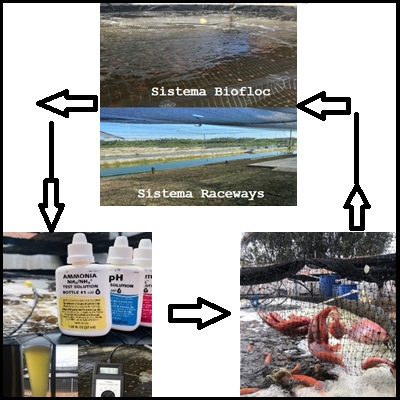
El estudio comparó la eficiencia productiva de la tilapia roja criada en estanques de geomembrana con tecnología biofloc y raceways. Se analizaron los parámetros fisicoquímicos clave en ambos sistemas, destacando correlaciones entre variables y su impacto en la calidad del agua y el rendimiento de los peces. En biofloc, se encontró una presión positiva moderada entre oxígeno disuelto, pH y temperatura, resaltando la importancia de mantener niveles óptimos de oxígeno. En raceways, se halló una fuerte variación positiva entre oxígeno disuelto y pH, subrayando la influencia del pH en la disponibilidad de oxígeno. No se encontraron diferencias significativas en tasas de alimentación, conversión alimentaria, mortalidad y supervivencia entre los sistemas, indicando su igual eficacia productiva y control de la mortalidad. Estos hallazgos respaldan que tanto biofloc como raceways son opciones viables para el cultivo de tilapia, con resultados comparables en calidad del agua, rendimiento de los peces y eficiencia económica. Este estudio puede orientar a productores acuícolas en la elección del sistema de cultivo más adecuado según sus necesidades y condiciones específicas.
Descargas
Referencias
Organización de las Naciones Unidad para la Alimentación y la Agricultura, El estado mundial de la pesca y la acuicultura, Hacia la transformación azul. FAO, 2022. doi: 10.4060/cc0461es.
Y. A. Sarabia Parrado, “Historia de la Acuicultura en Colombia ,” Revista AquaTIC, vol. 37, pp. 60–76, 2016.
L. E. Hernández Mancipe, J. I. Londoño Velez, K. A. Hernández García, and L. C. Torres Hernández, “Los sistemas biofloc: una estrategia eficiente en la producción acuícola,” CES Medicina Veterinaria y Zootecnia, vol. 14, no. 1, pp. 70–99, Apr. 2019, doi: 10.21615/cesmvz.14.1.6.
C. Ramírez López, H. V. Perales Vela, and L. Fernández Linares, “Biomass and lipid production from Chlorella vulgaris UTEX 26 cultivated in 2 m3 raceway ponds under semicontinuous mode during the spring season,” Bioresour Technol, vol. 274, pp. 252–260, Feb. 2019, doi: 10.1016/j.biortech.2018.11.096.
E. Villar Navarro, J. Ruiz, C. Garrido Pérez, and J. A. Perales, “Microalgae biotechnology for simultaneous water treatment and feed ingredient production in aquaculture,” Journal of Water Process Engineering, vol. 49, p. 103115, Oct. 2022, doi: 10.1016/j.jwpe.2022.103115.
L. H. David, S. M. Pinho, K. J. Keesman, and F. Garcia, “Assessing the sustainability of tilapia farming in biofloc based culture using emergy synthesis,” Ecol Indic, vol. 131, p. 108186, Nov. 2021, doi: 10.1016/j.ecolind.2021.108186.
I. Instituto de Hidrología Meteorología y Estudios Ambientales, “Boletín Predicción climática ,” Colombia , 2022.
S. Deb, Md. T. Noori, and P. S. Rao, “Application of biofloc technology for Indian major carp culture (polyculture) along with water quality management,” Aquac Eng, vol. 91, p. 102106, Nov. 2020, doi: 10.1016/j.aquaeng.2020.102106.
R. M. Shourbela, W. N. El Hawarry, M. R. Elfadadny, and M. A. O. Dawood, “Oregano essential oil enhanced the growth performance, immunity, and antioxidative status of Nile tilapia (Oreochromis niloticus) reared under intensive systems,” Aquaculture, vol. 542, p. 736868, Sep. 2021, doi: 10.1016/j.aquaculture.2021.736868.
Y. Avnimelech, Biofloc technology: a practical guide book. USA, 2009.
T. Yoshimatsu and M. A. Hossain, “Recent advances in the high-density rotifer culture in Japan,” Aquaculture International, vol. 22, no. 5, pp. 1587–1603, Oct. 2014, doi: 10.1007/s10499-014-9767-5.
R. B. König, P. S. Furtado, W. Wasielesky, and P. C. Abreu, “Effect of hydrogen peroxide on the microbial community present in biofloc production systems of the shrimp Litopenaeus vannamei,” Aquaculture, vol. 533, p. 736155, Feb. 2021, doi: 10.1016/j.aquaculture.2020.736155.
L. Fantini-Hoag, T. Hanson, and J. Chappell, “Production trials of in-pond raceway system growing stocker and foodsize hybrid Catfish plus Nile tilapia,” Aquaculture, vol. 561, p. 738582, Dec. 2022, doi: 10.1016/j.aquaculture.2022.738582.
T. Abinaya, J. Ishwarya, and M. Maheswari, “A Novel Methodology for Monitoring and Controlling of Water Quality in Aquaculture using Internet of Things (IoT),” in 2019 International Conference on Computer Communication and Informatics (ICCCI), IEEE, Jan. 2019, pp. 1–4. doi: 10.1109/ICCCI.2019.8821988.
Y. B. Yu et al., “The application and future of biofloc technology (BFT) in aquaculture industry: A review,” J Environ Manage, vol. 342, p. 118237, Sep. 2023, doi: 10.1016/j.jenvman.2023.118237.
M. H. Khanjani, A. Mohammadi, and M. G. C. Emerenciano, “Microorganisms in biofloc aquaculture system,” Aquac Rep, vol. 26, p. 101300, Oct. 2022, doi: 10.1016/j.aqrep.2022.101300.
A. A. H. Abdel Latef, M. F. Abu Alhmad, M. Kordrostami, A. B. A. E. Abo–Baker, and A. Zakir, “Inoculation with Azospirillum lipoferum or Azotobacter chroococcum Reinforces Maize Growth by Improving Physiological Activities Under Saline Conditions,” J Plant Growth Regul, vol. 39, no. 3, pp. 1293–1306, Sep. 2020, doi: 10.1007/s00344-020-10065-9.
R. S. A. White, P. A. McHugh, C. N. Glover, and A. R. McIntosh, “Multiple environmental stressors increase the realised niche breadth of a forest dwelling fish,” Ecography, vol. 38, no. 2, pp. 154–162, Feb. 2015, doi: 10.1111/ecog.00526.
El SherifSaadMohamed and El Feky Mohamed Ibrahim, “Performance of Nile Tilapia (Oreochromis niloticus) Fingerlings. I. Effect of pH ,” Int J Agric Biol, vol. 11, pp. 297–300, 2009.
R. Saldaña Escorcia, M. Salazar Sánchez, L. Rodriguez barbosa, I. Hernandez Martinez, and N. Sánchez Álvarez, “Avances en investigación científica. Tomo III: Ciencias multidisciplinarias. Calidad del agua para el cultivo de tilapia roja (Oreochromis sp.) en etapa de alevinaje con tecnología biofloc ,” 1st ed., vol. 3, Nariño : Sello editorial AUNAR Cali, 2022, pp. 289–301. doi: 10.47666/avances.inv.3.
X. Chen, G. Luo, J. Tan, H. Tan, and M. Yao, “Effects of carbohydrate supply strategies and biofloc concentrations on the growth performance of African catfish (Clarias gariepinus) cultured in biofloc systems,” Aquaculture, vol. 517, p. 734808, Feb. 2020, doi: 10.1016/j.aquaculture.2019.734808.
M. E. Abd El Hack et al., “Effect of environmental factors on growth performance of Nile tilapia (Oreochromis niloticus),” Int J Biometeorol, vol. 66, no. 11, pp. 2183–2194, Nov. 2022, doi: 10.1007/s00484-022-02347-6.
S. M. Levit, A Literature Review ofEffects of Ammonia on Fish , Montana. Montana : The Nature Conservancy, 2010.
M. S. El Sherif and A. M. El Feky, “ Effect of ammonia on Nile tilapia (O. niloticus) performance and some hematological and histological measures,” Eighth International Symposium on Tilapia in Aquaculture, pp. 17–22, Oct. 2008.
M. S. Ali, S. M. Stead, and D. F. Houlihan, “Effects of socking [sic] density on ammonia excretion and the growth of Nile tilapia (Oreochromis niloticus L.),” aquadocs, pp. 13–24, Feb. 2006.
M. del C. Monroy-Dosta, R. De Lara-Andrade, J. Castro-Mejía, G. Castro-Mejía, and M. G. Coelho-Emerenciano, “Composición y abundancia de comunidades microbianas asociadas al biofloc en un cultivo de tilapia,” Rev Biol Mar Oceanogr, vol. 48, no. 3, pp. 511–520, Dec. 2013, doi: 10.4067/S0718-19572013000300009.
L. K. Oliveira, L. Pilz, P. S. Furtado, E. L. C. Ballester, and Á. J. de A. Bicudo, “Growth, nutritional efficiency, and profitability of juvenile GIFT strain of Nile tilapia (Oreochromis niloticus) reared in biofloc system on graded feeding rates,” Aquaculture, vol. 541, p. 736830, Aug. 2021, doi: 10.1016/j.aquaculture.2021.736830.
B. Suárez-Puerto, M. Delgadillo-Díaz, M. J. Sánchez-Solís, and M. Gullian-Klanian, “Analysis of the cost-effectiveness and growth of Nile tilapia (Oreochromis niloticus) in biofloc and green water technologies during two seasons,” Aquaculture, vol. 538, p. 736534, May 2021, doi: 10.1016/j.aquaculture.2021.736534.
P. E. Paz, A. D. Martinez Turcios, and J. I. Chávez Chávez, “Producción de tilapia (Oreochromis niloticus L.) en la etapa de engorde con dos estrategias de alimentación,” Ceiba, no. 0843, pp. 1–6, Jan. 2019, doi: 10.5377/ceiba.v0i0843.5824.
S. B. Brú-Cordero, V. Pertúz-Buelvas, J. Ayazo-Genes, V. J. Atencio-García, and S. Pardo-Carrasco, “Bicultivo de cachama blanca <i>Piaractus brachypomus</i> y tilapia nilótica <i>Oreochromis niloticus</i> en biofloc alimentadascon dietas de origen vegetal,” Revista de la Facultad de Medicina Veterinaria y de Zootecnia, vol. 64, no. 1, pp. 44–60, Jan. 2017, doi: 10.15446/rfmvz.v64n1.65824.
Descargas
Publicado
Número
Sección
Licencia
Derechos de autor 2025 Ingris Yohana Hernandez Martinez, Margarita Del Rosario Salazar Sánchez, Luis Francisco Pereira Flores

Esta obra está bajo una licencia internacional Creative Commons Atribución-NoComercial-SinDerivadas 4.0.