Efectos de la presión hidrostática sobre los modos defectivos en un cristal fotónico bidimensional semiconductor con geometría hexagonal
DOI:
https://doi.org/10.24054/bistua.v18i1.208Keywords:
Cristal fotónico, presión hidrostática, estructura de bandas, método de expansión en ondas planas, modos localizadosAbstract
Las propiedades ópticas de las estructuras caracterizadas mediante una función dieléctrica periódica como los cristales fotónicos (CFs), ha despertado interés por sus aplicaciones en diversos campos de la óptica y la optoelectrónica. Cuando la periodicidad de los CFs se rompe por la inserción de defectos, permite el confinamiento de modos de luz. En esta contribución, utilizando el método de expansión en ondas planas para el modo de polarización transversal magnética y el Software computacional MATLAB, se estudia el efecto de la presión hidrostática sobre la estructura de bandas en un cristal fotónico bidimensional (CF-2D) con red hexagonal, compuesto por agujeros de aire en un fondo de material semiconductor de
fosfuro de galio (GaP), que se caracteriza por tener el índice de refracción más alto entre los semiconductores binarios y su rango de transmisión se utiliza en aplicaciones de luz visible e infrarrojo cercano. Inicialmente, se estudia la relación de dispersión del cristal fotónico regular (sin defecto) y se analiza la zona de Banda Fotónica Prohibida (BFP); posteriormente se
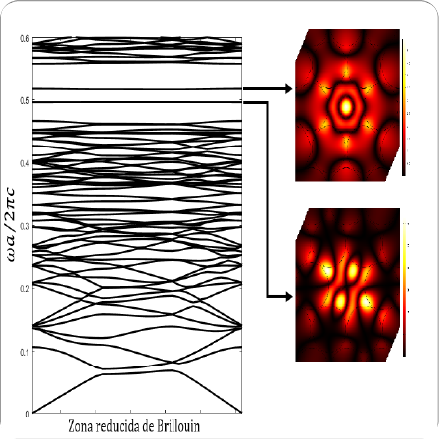
aumenta la presión hidrostática, generando que la estructura de banda fotónica presente un desplazamiento a regiones de alta frecuencia. Posteriormente, utilizando la técnica de la supercelda se considera un defecto puntual dentro de la estructura, que reemplaza un agujero de aire por material semiconductor, que genera estados permitidos o modos de defecto en el interior del bandgap fotónico. Al aumentar la presión hidrostática se observa que el ancho del bandgap fotónico permanece inalterado y los modos de defecto presentan un desplazamiento a valores de altas frecuencias.
Downloads
References
Massaro A. Photonic Crystals: Introduction, Applications and Theory. 1st ed. InTechOpen, 2012.
Joannopoulos J., Johnson S., Winn J., Meade R. Photonic Crystals: Molding the Flow of Light. 2nd ed. Princeton University Press, 2008.
Yablonovitch E. Inhibited spontaneous emission in solid-state physics and electronics. Physical Review Letters, 58(20) (1987) 2059-2062. https://doi.org/10.1103/PhysRevLett.58.2059
John S. Strong localization of photons in certain disordered dielectric superlattices. Physical Review Letters, 58(23) (1987) 2486-2489. https://doi.org/10.1103/PhysRevLett.58.2486
Dressel M., Gruner G. Electrodynamics of Solids: Optical Properties of Electrons in Matter. 1st ed. Cambridge University Press, 2002.
Ashcroft N., Mermin D., Wei D. Solid State Physics. Cengage Learning Asia, 2016.
Gong Q., Hu X. Photonic Crystals: Principles and Applications. 1st ed. Pan Stanford Publishing, 2013.
Obayya S., Farhat M., Hameed O., Areed N. Computational Liquid Crystal Photonics: Fundamentals, Modelling and Application. Wiley, 2016.
Hameed M., Obayya S. Computational Photonic Sensors. Springer, 2018.
Yablonovitch E. Photonic crystals: semiconductors of light. Scientific American, 285(6) (2001) 46-55. https://doi.org/10.1038/scientificamerican1201-46
Sanchez A., Porta A., Orozco S. Photonic band-gap and defect modes of a one-dimensional photonic crystal under localized compression. Journal of Applied Physics, 121(17) (2017) 173101. https://doi.org/10.1063/1.4982760
Gharaati A., Zare Z. The effect of temperature on one-dimensional nanometallic photonic crystals with coupled defects. Pramana - Journal of Physics, 88(5) (2017) 75. https://doi.org/10.1007/s12043-017-1380-5
Berman O., Lozovik Y., Eiderman S., Coalson R. Superconducting photonic crystals: numerical calculations of the band structure. Physical Review B, 74(9) (2006) 092505. https://doi.org/10.1103/PhysRevB.74.092505
Liu N., Guo H., Fu L., Kaiser S., Schweizer H., Giessen H. Three-dimensional photonic metamaterials at optical frequencies. Nature Materials, 7(1) (2008) 31-37. https://doi.org/10.1038/nmat2072
Lin M., Jao R. Finite element analysis of photon density of states for two-dimensional photonic crystals with in-plane light propagation. Optics Express, 15(1) (2007) 207-218. https://doi.org/10.1364/OE.15.000207
Taflove A., Hagness S. Computational Electrodynamics: The Finite-Difference Time-Domain Method. 3rd ed. Artech House Publishers, 2005.
Shumpert J. Modeling of Periodic Dielectric Structures (Electromagnetic Crystals). Ph.D. thesis, University of Michigan, 2001.
Skorobogatiy M., Yang J. Fundamentals of Photonic Crystal Guiding. 1st ed. Cambridge University Press, 2009.
Sakoda K. Optical Properties of Photonic Crystals. 2nd ed. Springer, 2004.
Sozuer H., Haus J., Inguva R. Photonic bands: convergence problems with the plane-wave method. Physical Review B, 45(24) (1992) 13962-13972. https://doi.org/10.1103/PhysRevB.45.13962
Aly A., Elsayed H., El-Naggar S. Tuning the flow of light in two-dimensional metallic photonic crystals based on Faraday effect. Journal of Modern Optics, 64(1) (2017) 74-80. https://doi.org/10.1080/09500340.2016.1208298
Duque C., Mora-Ramos M. The two-dimensional square and triangular photonic lattice under the effects of magnetic field, hydrostatic pressure and temperature. Optical and Quantum Electronics, 44(8-9) (2012) 375-392. https://doi.org/10.1007/s11082-012-9545-4
Porras-Montenegro N., Duque C. Temperature and hydrostatic pressure effects on the photonic band structure of a 2D honeycomb lattice. Physica E: Low-Dimensional Systems and Nanostructures, 42(6) (2010) 1865-1869. https://doi.org/10.1016/j.physe.2010.02.016
Segovia F., Vinck H. Effects of hydrostatic pressure on the band structure in two-dimensional semiconductor square photonic lattice with defect. Physica B: Condensed Matter, 545 (2018) 203-209. https://doi.org/10.1016/j.physb.2018.06.014
Orfanidis S. Electromagnetic Waves and Antennas. Rutgers University, New Brunswick, NJ, 2002.
Kittel C. Introduction to Solid State Physics. 8th ed. Wiley, 2004.
Samara G. Temperature and pressure dependences of the dielectric constants of semiconductors. Physical Review B, 27(6) (1983) 3494-3505. https://doi.org/10.1103/PhysRevB.27.3494
Sukhoivanov I., Guryev I. Photonic Crystals: Physics and Practical Modeling. Springer, 2009.
Shangping G. Photonic Crystals: Modeling and Simulation. Ph.D. thesis, Department of Electrical and Computer Engineering, Old Dominion University, Norfolk, VA, 2003.
Wu L., Zhuang F., He S. Degeneracy analysis for a supercell of a photonic crystal and its applications to the creation of band gaps. Physical Review E, 67(2) (2003) 026612. https://doi.org/10.1103/PhysRevE.67.026612
Downloads
Published
Issue
Section
License
Copyright (c) 2020 Juan Sebastián Soto Perdomo, Emiro Segundo Arrieta Jiménez

This work is licensed under a Creative Commons Attribution-NonCommercial-NoDerivatives 4.0 International License.