Study of the abrasiveness of rocks and its impact on drilling and consumption of bits and cutters. Colombian case
DOI:
https://doi.org/10.24054/bistua.v20i1.1365Keywords:
Abrasiveness, Quartz Equivalent Content, Cerchar Index, Schimazek Index, Compressive strength, Tensile strengthAbstract
Abrasivity is one of the most important properties that influence the cost of processes such as drilling, blasting and comminution. This characteristic depends largely on the mineralogical composition, texture, structure and porosity of the rocks, characteristics that demand, for its determination, a careful petrographic examination, as well as the determination of the mechanical properties of compressive strength and indirect tensile strength of the rocks. But other more appropriate tests require the determination of the DRI, the CAI, the AVS and the CLI, among others.
In our environment it is not very common to carry out these studies and when they are carried out, only those that require at most the petrographic study accompanied by the determination of the resistance properties of the intact material appear; however, today we have laboratories where the determination of the CAI can be carried out and when we have had to carry out more detailed studies such as the Tarkoy Hardness, for example, we have had to send the samples abroad.
To disseminate these test methods, we undertook the task of refining, organizing and processing the results of a study we conducted in 2004 on the material exploited in a quarry located in the rock massif of northern Caldas, consisting of a Gneiss and a very abrasive and resistant Wollastonite Shale whose exploitation demanded a high cost in drilling and blasting.
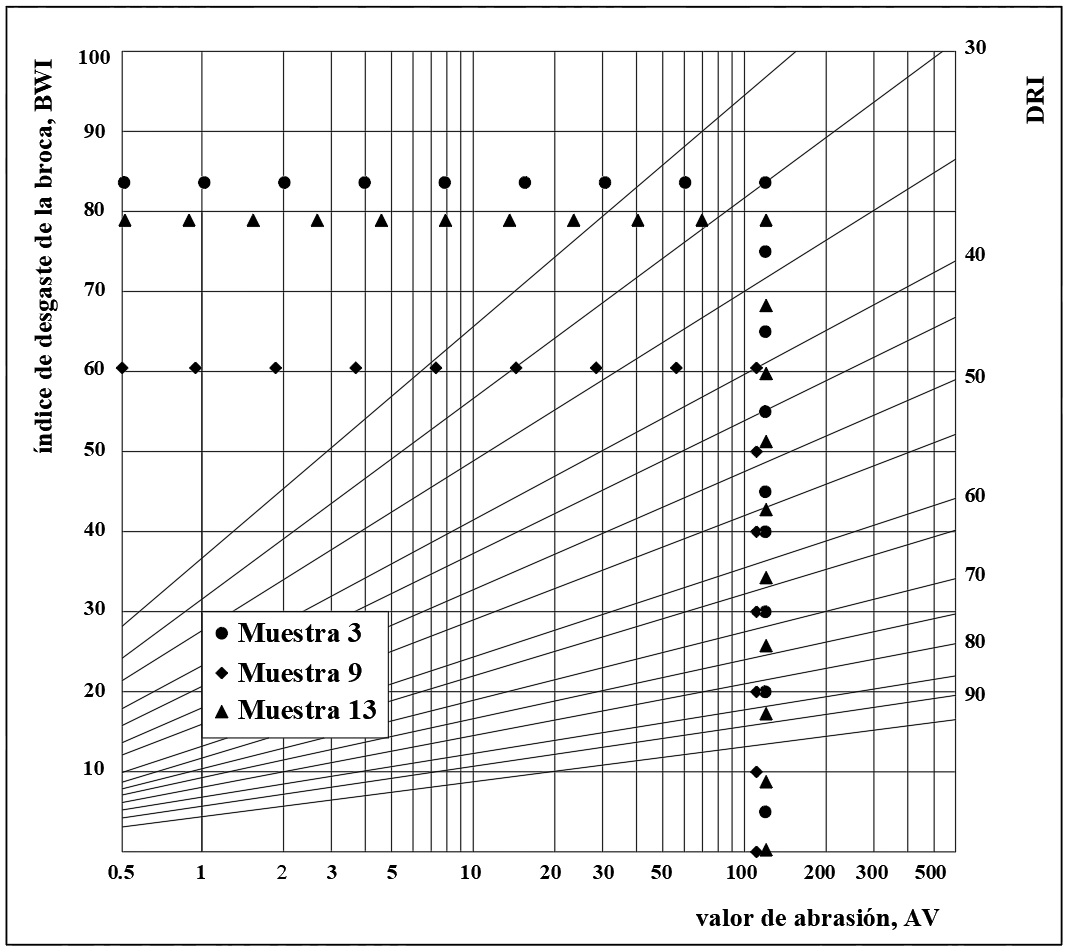
The study carried out on 14 Gneiss samples tested for AMC, VH, EQC, RAI, CAI, FSchim, LAC, HT, DRI, AVS, CLI and BWI abrasivities confirms this. Indeed, the material was found to have a high to extremely high abrasiveness, as well as a very high BWI, and a low to very low DRI and CLI.
Downloads
References
Correa ArroyaveÁ et al., “Estudio de la abrasividad y otras propiedades físicas y mecánicas de las rocas explotadas en la cantera Puente Hierro II”Bogotá,(2004),205 pp.
EllecostaP.,“Determining abrasivity for hard rock TBM tunnelling”. Tesis de Doctor-Ingeniero en la Technische Universität München, Munich, Alemania, (2020), 255 pp.
Majeed, Y., Abu Bakar, M.Z. & Butt, I.A. “Abrasivity evaluation for wear prediction of button drill bits using geotechnical rock properties”. Bull Eng Geol Environ 79, 767–787 (2020). https://doi.org/10.1007/s10064-019-01587-y.
YagizS., RostamiJ.,&OzdemirL.,“Recommended rock testing methods for predicting TBM performance: focus on the CSM and NTNU models”. ISRM International Symposium (2008).
Correa ArroyaveÁ.,“Serie completa de los métodos recomendados por la ISRM para la caracterización de rocas en laboratorio”, ISBN 978-958-98770-5-0, Bogotá, 2013,388 pp.
Llinás R. D., “Resultados ensayos petrográficos muestras de roca, Cantera Puente Hierro II”. Bogotá, (2004).
GhasemiA.,“Studyof Cerchar Abrasivity Index and potential modifications for more consistent measurement of rock abrasion”. The Pennsylvania State University,Thesis,August (2010).
Schimazek, J. y Knatz, H. “Die beurteilung der bearbeitbarkeit von gesteinen durch schneid-und rollenbohrwerkzeuge”. Erzmetall, 29(3): 113-119, (1976).
Ewendt, G., “Erfassung der Gesteinsabrasivitat und Prognose des WerkzeugverschleiBes beim maschinellen Tunnelvortrieb mit DiskenmeiBeln”. Bochumer Geologische und Geot-echnische Arbeiten, 33, (1989).
Tarkoy P.J.,“Predicting TBM penetration rates In Selected rock types”.Proc., 9thCanadian Symposium on Rock Mechanics, Montreal, Quebec, Dec. 13-15,(1973).
Tarkoy, Peter J.,“Practical geotechnical and engineering properties for tunnel-boring machine performance analysis and prediction.” Transportation Research Record,(1986).
López Jimeno C.et al.,“Manual de perforación en túneles. Capítulo 2. Propiedades de las rocas y de los macizos rocosos y su perforabilidad”, ETSI-Minas, Universidad Politécnica de Madrid, Madrid, pp47-106.(2013).
Meng F et al., “Rock brittleness indices and their applications to different fields of rock engineering: A review”, Journal of Rock Mechanics and Geotechnical Engineering, https://doi.org/10.1016/j.jrmge.2020.06.008.
Dahl F., “DRI, BWI, CLI Standards”. NTNU, Angleggsdrift, Trondheim, (2003).
Giraldo Paredez E.M.,“Las máquinas tuneleras tipo “TBM” como alternativa al sistema de perforación y voladura para la excavación de túneles caso: desarrollo de túneles en Yuncan”. Universidad Nacional de Ingeniería, Facultad de Ingeniería geológica, minera y metalúrgica. Tesis de Maestro en Ciencias con Mención en Ingeniería de Minas, Lima-Perú.,(2010).
Downloads
Published
Versions
- 2022-10-26 (5)
- 2022-08-12 (4)
- 2022-07-30 (3)
- 2022-07-30 (2)
- 2022-07-11 (1)
Issue
Section
License
Copyright (c) 2022 Álvaro de la Cruz Correa Arroyave, Jorge Eric Rueda Fonseca

This work is licensed under a Creative Commons Attribution-NonCommercial-NoDerivatives 4.0 International License.