Landslide model using OpenFOAM applied to the area of Pamplona, Colombia
DOI:
https://doi.org/10.24054/bistua.v20i2.1343Keywords:
Landslide, Model, FluxAbstract
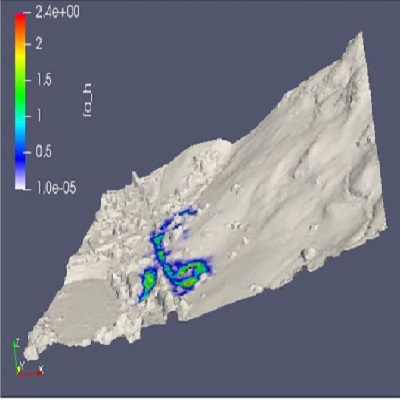
Catastrophic events have different origins, some of them happened in natural way and some others due to failures in facility or equipment created by human beings. Among the natural catastrophic events are landslides. It is widely known that landslides and debris flows are triggered by geological movements or heavy rainfall. Due to their geological, geomorphological and climatic configuration, some regions are more prone to the happening of this type of phenomena. In this study field, research has focused on the development of landslide prediction technology. In this work, a superficial landslide product of rains is simulated in which the geomaterial involved in the landslide can be modeled as a fluid, measurements are taken on the ground spot using a digital DEM elevation map and the characteristic parameters of the soil are obtained by means of seismic prospecting techniques, finally a rheological model is implemented which adapts to soil conditions and the OpenFOAM software is used to model a landslide in the km 1 zone via Bucaramanga, Pamplona Norte de Santander, where the extension of propagation of a possible landslide over the University of Pamplona is shown.
Downloads
References
Varnes, D. J. (1978). Slope movement types and processes. Special report, 176, (1978)11-33.
Hungr, O., Leroueil, S., Picarelli, L.,The Varnes classification of landslide types, an update. Landslides, 11(2)(2013)167-194. https://doi.org/10.1007/s10346-013-0436-y
Savage S.B., Hutter K., The motion of a finite mass of granular material down a rough incline.Journal of Fluid Mechanics, (1989)177-215. https://doi.org/10.1017/s0022112089000340
De Blasio F. V., Introduction to the Physics of Landslides, Dordrecht: Springer Netherlands (2011) 88-107
MatsumaruT., UzuokaR., Three-phase coupled analysis of unsaturated embankment subjected to rainfall infiltration and seismic motion, Unsaturated Soils: Research & Applications. CRC Press, (2014)597–603. https://doi.org/10.1201/b17034-83
MoriguchiS., YashimaA.,SawadaK., UzuokaR.,ItoM.,Numerical simulation of flow failure ofgeomaterials based on fluid dynamics, Soils and Foundations, 45(02)(2005)155–165. https://doi.org/10.3208/sandf.45.2_155
Rauter M., Kofler A., Fellin W., faSavageHutterFOAM 1.0: depth-integrated simulation of dense snow avalanches on natural terrain with OpenFOAM. Geoscientific ModelDevelopment, 11(7), (2018) 2923-2939. https://doi.org/10.5194/gmd-11-2923-2018
Greve, R., Koch, T., Hutter, K.: Unconfined Flow of Granular Avalanches along a Partly Curved Surface. I. Theory, P. Roy. Soc. Lond. A Mat., 445, (1994) 399–413, https://doi.org/10.1098/rspa.1994.0068
JGray J. M. N. T., Tai Y.C., S. Noelle, Shock waves, dead zones and particle-free regions in rapid granular free-surface flows, Journal of Fluid Mechanics, 491 (2003) 161-181 https://doi.org/10.1017/s0022112003005317
PudasainiS.P, EckartW,HutterK., Gravity-Driven rapid shear flows of dry granular masses in helically curved and twisted channels, Mathematical Models and Methods in Applied Sciences, 13(07)(2003)1019–1052. https://doi.org/10.1142/s0218202503002805
Wang, Y., Hutter, K.,Pudasaini, S. P.,The Savage-Hutter theory: A system of partial differential equations for avalanche flowsof snow, debris, and mud, ZAMM-Z, 84(8)(2004)507–527. https://doi.org/10.1002/zamm.200310123
HanertE.,Le Roux D.Y., LegatV., Deleersnijder, E.,An efficient Eulerian finite element method for the shallow water equations, Ocean Model., 10 (2005) )115–136. https://doi.org/10.1016/j.ocemod.2004.06.006
Christen M., Kowalski J., Bartelt, P.,RAMMS: Numerical simulation of dense snow avalanches in three dimensional terrain, Cold Reg. Sci. Technol., 63(2010)1–14. https://doi.org/10.1016/j.coldregions.2010.04.005
Sampl P.,Granig M..,Avalanche Simulation with SamosAT, in: Proceedings of the International Snow Science Workshop, Davos,27 (2009)519–523.
Rauter M., Tukovic, Z., A finite area scheme for shallow granular flows on three-dimensional surfaces. Computers & Fluids, 166 (2018) 184-199. https://doi.org/10.1016/j.compfluid.2018.02.017
Deckelnick K., DziukG., and Elliott, C. M.,Computation of geometric partial differential equations and mean curvature flow, Acta Numer.,14, (2005)139–232. https://doi.org/10.1017/S0962492904000224
TukovicZ.,JasakH.,A moving mesh finite volume interface tracking method for surface tension dominated interfacial fluid flow, Computers & Fluids, 55(2012) 70–84. https://doi.org/10.1016/j.compfluid.2011.11.003
PouliquenO.,Y. ForterreY.,Friction law for dense granular flows: Application to the motion of a mass down a rough inclined plane, Journal of Fluid Mechanics, vol. 453, (2002)133–151, https://doi.org/10.1017/s0022112001006796
JopP., ForterreY.,PouliquenO., A constitutive law for dense granular flows, Nature, 441(7094)(2006).727–730, https://doi.org/10.1038/nature04801
Voellmy A., Über die Zerstörungs kraft von Lawinen., Schweizerische Bauzeitung 73 (15).
Medina V., Hürlimann M., Bateman A. ,Application of FLAT Model, a 2D finite volume code, to debris flows in the northeastern part of the Iberian Peninsula. Landslides, 5(1)(2007)127–142. https://doi.org/10.1007/s10346-007-0102-3
Downloads
Published
Issue
Section
License
Copyright (c) 2022 Edwin Fernando Acevedo Rodríguez, Francisco Cabrera, Juan Carlos Serrano Rico

This work is licensed under a Creative Commons Attribution-NonCommercial-NoDerivatives 4.0 International License.