Temporary assessment of birds, insects, and plants diversity in the Sucre Educational Institution, Colón, Putumayo
DOI:
https://doi.org/10.24054/raaas.v17i2.4690Keywords:
biodiversity, ecological indices, species richness, seasonality, biological communityAbstract
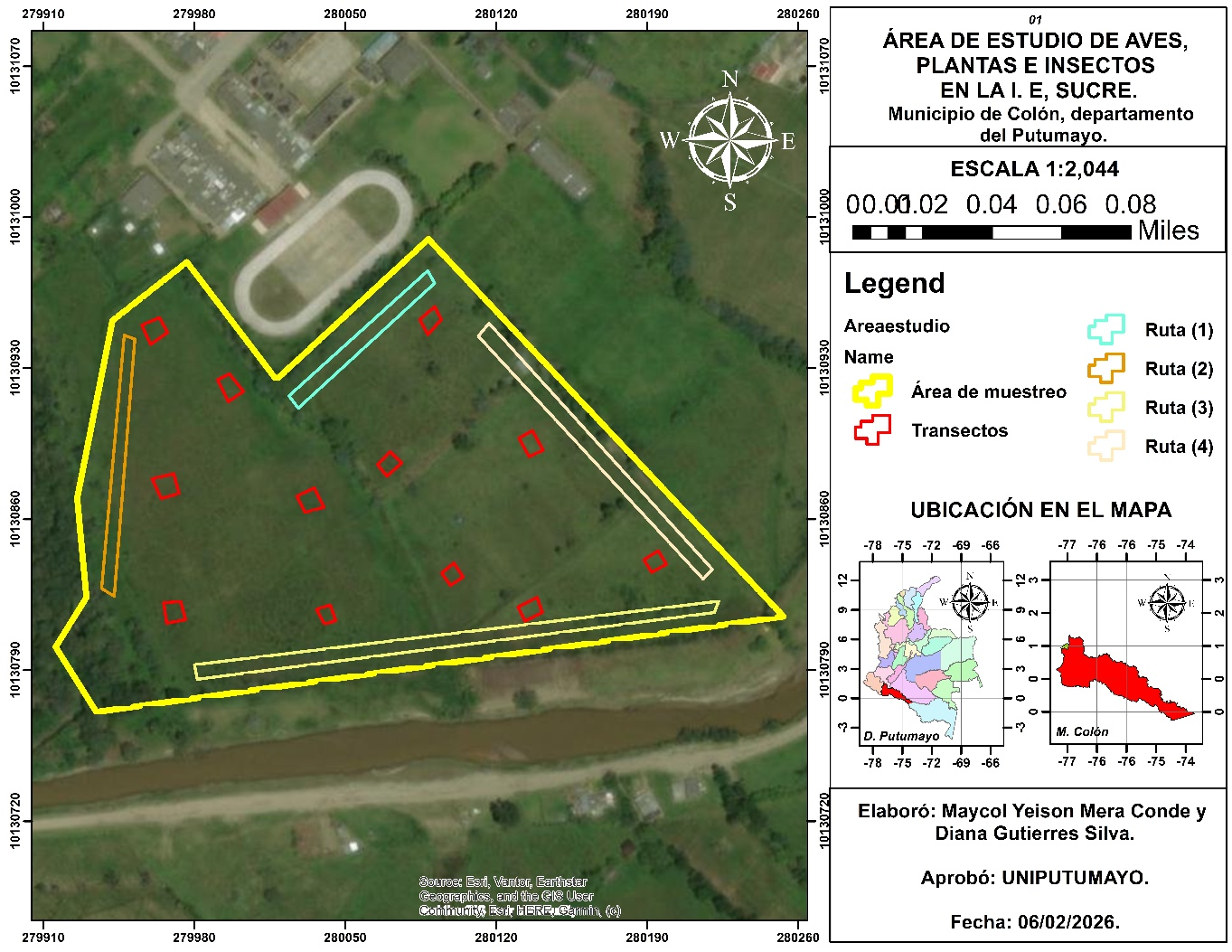
Biodiversity in Andean-Amazonian ecosystems plays an important role in maintaining ecological balance and ecosystem services; however, it is exposed to pressures from climatic variability and anthropogenic activities. In this context, the present study aimed to evaluate the alpha diversity of birds, insects, and plants across two climatic seasons at the Experimental Farm of the Sucre Educational Institution, located in the municipality of Colón, Putumayo. For this study, sampling methods were applied according to each taxonomic group, including direct observation for birds, manual collection and entomological nets for insects, and transects for vegetation recording. The data obtained were analyzed using the Shannon–Wiener, Simpson, and Margalef diversity indices, complemented by Hutcheson’s t-test to determine significant differences between seasons. The results revealed specific response patterns to seasonality, showing high diversity in insects, stability in the bird community, and a significant decrease in plant diversity during the dry season. These findings reflect the influence of climatic conditions, particularly water availability, on the structure and dynamics of biological communities. It is concluded that biodiversity in disturbed ecosystems responds differently to climatic variations, depending on the ecological characteristics of each taxonomic group. In this sense, the study establishes a relevant baseline for ecological monitoring and provides key information for the development of conservation strategies and sustainable management in the region.
Downloads
References
Ali, H., Rafiq, M., Manzoor, M., Gillani, S. W., Degen, A., Iqbal, A., Wang, W., Rafiq, M. K., & Shang, Z. (2026). Seasonal shifts in vegetation, soil properties, and microbial communities in Western Himalayan forests. Environmental Microbiome, 21(1), 22-. https://doi.org/10.1186/S40793-025-00842-Y
Ardila-Bayona, V., Alfonso-Sosa, I., Flórez-Valencia, C., Valderrama-Gómez, D. A., Mesa-Bermúdez, A., Pabón-Huertas, L. D., Pineda, E. D. T., & González, M. C. (2025). Diversidad de membrácidos y aetaliónidos del bosque seco tropical de la Ecoreserva La Tribuna, Neiva. Biota Colombiana, 26. https://doi.org/10.21068/2539200X.1266
Awash, N., & Tekalign, W. (2023). Comparison of bird assemblage structures and diversity patterns between seasons among two Ethiopian wetlands. BMC Zoology, 8(1), 3-. https://doi.org/10.1186/S40850-023-00164-X
Bañares-de-Dios, G., Macía, M. J., Arellano, G., Cerda, Í. G. la, Vega-Álvarez, J., Arnelas, I., Espinosa, C. I., Salinas, N., & Cayuela, L. (2023). Woody plant taxonomic, functional, and phylogenetic diversity decrease along elevational gradients in Andean tropical montane forests: environmental filtering and arrival of temperate taxa. BioRxiv. https://doi.org/10.1101/2023.08.05.551864
Cairo Sosa, Y., Morejón García, M., Reinaldo Díaz Rivera, J., Miguel Miranda Cruz, Y., & Rodríguez Valdés, D. (2026). Caracterización de la agrobiodiversidad en dos sistemas productivos de café (Coffea arabica) en La Cidra. ECOVIDA, 15(2), 116–129. https://revistaecovida.upr.edu.cu/index.php/ecovida/article/view/332
Calderón-Caro, J., Morales-Gómez, L. M., Gutiérrez-Vélez, V. H., González-Caro, S., & Benavides, A. M. (2024). Modeling proximate causes of deforestation in Antioquia, Colombia. Regional Environmental Change, 24, 149-. https://doi.org/10.1007/S10113-024-02302-8
Camero-R., E., Murcia-Betancourt, L. M., Zúñiga-Totena, M. A., & García-Marín, S. (2022). Entomofauna del campus de la Universidad Nacional de Colombia, sede Bogotá: Parámetros descriptivos de su composición y su abundancia. Revista Colombiana de Entomología, 48(2), 1–10. https://doi.org/10.25100/socolen.v48i2.11726
Cano-Cobos, Y., Bota-Sierra, C. A., & Mendoza-Penagos, C. (2023). Ten new records of Odonata for Colombia (Coenagrionidae, Aeshnidae). Biota Colombiana, 24(2), 1112. https://doi.org/10.21068/2539200X.1112
Chen, L., Münzbergová, Z., Feng, Y., Jiang, L., Zhang, J., Ding, Y., Long, W., Chen, Y., Feng, J., & Liu, L. (2025). Dry conditions and low plant diversity increase foliar disease occurrence along a tropical montane elevational gradient. Forest Ecology and Management, 597, 123071. https://doi.org/10.1016/J.FORECO.2025.123071
Collantes G, R. D., Del Cid, R. A., Santos-Murgas, A., & Atencio, R. V. (2023). Importancia de los insectos polinizadores en la sostenibilidad de los agroecosistemas productivos. Semilla Del Este, 3(2), 8–2026. https://revistas.up.ac.pa/index.php/semilla_este/article/view/3755
De Ruyck, C. C., & Koper, N. (2024). Diets of small-island tropical birds suggest generalist/opportunistic foraging niches and the conservation value of diverse agroecosystems. The Wilson Journal of Ornithology, 136(2), 179–195. https://doi.org/10.1676/23-00058
Díaz-Cháux, J. T., Velasquez-Valencia, A., Martínez-Salinas, A., & Casanoves, F. (2025). Functional Diversity and Ecosystem Services of Birds in Productive Landscapes of the Colombian Amazon. Diversity, 17(5), 305. https://doi.org/10.3390/D17050305/S1
Duque-Vélez, P., Olivera-Angel, M., & Wolff, M. (2022). Silvopastoral systems as an alternative for conservation of dung beetles (Coleoptera: Scarabaeinae) in a cattle landscape in Caucasia Colombia. Caldasia, 44(1), 184–193. https://doi.org/10.15446/caldasia.v44n1.83102
Fernández Toro, L. E., Bonilla Cuspian, S., Palencia Fajardo, O., & Saavedra Mora, D. (2023). Las huertas con plantas medicinales como estrategia para el fortalecimiento de los resultados de aprendizaje en la Granja Experimental Corhuila: Sistematización de la Experiencia. Revista Agropecuaria y Agroindustrial La Angostura, 8(1), 22–33. https://doi.org/10.23850/RAA.V8I1.5807
Ferrante, M., Liebke, D. F., Hass, A. L., Wollenweber, M., Zembold, K., Arimond, I., Schüler, S., & Westphal, C. (2025). Landscape diversity can promote functional diversity of spider assemblages while habitat characteristics filter for specific traits. Functional Ecology, 39(11), 3152–3163. https://doi.org/10.1111/1365-2435.70150;PAGE:STRING:ARTICLE/CHAPTER
Gallego, D., Sabah, S. C., Lencina, J. L., & Carrillo, A. F. (2023). Bioclimatic and Landscape Factors drive the Potential Distribution of Philaenus spumarius, Neophilaenus campestris and N. lineatus (Hemiptera, Aphrophoridae) in Southeastern Iberian Peninsula. Insects, 14(7), 592. https://doi.org/10.3390/INSECTS14070592/S1
Gonzáles Lozano, H. T. (2020). Guías técnicas para el manejo de insectos con criterios ecológicos. In Anales del Instituto de la Patagonia (Vol. 39, Number 1). Centro Latinoamericano de Especies Menores (CLEM). https://doi.org/10.4067/S0718-686X2011000100005
Hackett, T. D., Sauve, A. M. C., Maia, K. P., Montoya, D., Davies, N., Archer, R., Potts, S. G., Tylianakis, J. M., Vaughan, I. P., & Memmott, J. (2024). Multi-habitat landscapes are more diverse and stable with improved function. Nature, 633(8028), 114–119. https://doi.org/10.1038/s41586-024-07825-y
Hänchen, L., Klein, C., Maussion, F., Gurgiser, W., Calanca, P., & Wohlfahrt, G. (2022). Widespread greening suggests increased dry-season plant water availability in the Rio Santa valley, Peruvian Andes. Earth System Dynamics, 13(1), 595–611. https://doi.org/10.5194/ESD-13-595-2022
Joseph, R., Apollon, W., & De Oliveira, A. C. (2025). The stressing point: how plants respond to environmental stimuli. Biotechnology Advances, 84, 108691. https://doi.org/10.1016/J.BIOTECHADV.2025.108691
Kang, X., Liu, Y., Wu, X., Duan, L., Jiang, J., Zhang, A., & Qi, W. (2025). Climate and soil factors drive the functional and phylogenetic assembly of Qinghai-Tibetan grassland communities via multiple paths. Basic and Applied Ecology, 83, 109–117. https://doi.org/10.1016/J.BAAE.2025.01.011
Krumhansl, K., Gentleman, W., Lee, K., Ramey-Balci, P., Goodwin, J., Wang, Z., Lowen, B., Lyons, D., Therriault, T. W., & DiBacco, C. (2023). Permeability of coastal biogeographic barriers to marine larval dispersal on the east and west coasts of North America. Global Ecology and Biogeography, 32(6), 945–961. https://doi.org/10.1111/GEB.13654;WGROUP:STRING:PUBLICATION
Lo, Y. C., Blamires, S. J., Liao, C. P., & Tso, I. M. (2023). Nocturnal and diurnal predator and prey interactions with crab spider color polymorphs. Behavioral Ecology and Sociobiology, 77(2), 19-. https://doi.org/10.1007/S00265-023-03291-0
Luzuriaga-Aveiga, V. E., & Cisneros-Heredia, D. F. (2022). Seasonal turnover of avian community assembly in a highly fragmented Tumbesian dry forest of southwestern Ecuador. Neotropical Biodiversity, 8(1), 229–241. https://doi.org/10.1080/23766808.2022.2076784
Martinez Arevalo, J. V. (2022). El cálculo de diversidad biológica. Parte I: Diversidad biológica alfa. Tikalia, 41(1), 48–62. https://www.researchgate.net/profile/Jose-Vicente-Martinez-Arevalo/publication/372854379_El_calculo_de_diversidad_biologica_Parte_I_Diversidad_biologica_alfa/links/64ca8f3c91fb036ba6bfa747/El-calculo-de-diversidad-biologica-Parte-I-Diversidad-biologica-alfa.pdf
Martinez Arevalo, J. V. (2023). El cálculo de diversidad biológica. Parte I: Diversidad biológica alfa. Tikalia, 41(1), 48–62. https://www.researchgate.net/publication/372854379_El_calculo_de_diversidad_biologica_Parte_I_Diversidad_biologica_alfa
Martínez Garcia, M., & Chaparro Africano, A. (2024). Vista de Áreas verdes institucionales y su aporte a la protección de la biodiversidad colombiana: caso UNIMINUTO, sede Bogotá. Mutis, 14(2), 1–21. https://revistas.utadeo.edu.co/index.php/mutis/article/view/areas-verdes-institucionales-aporte-proteccion-biodiversidad-colombiana/2170
Molina, A., Vanacker, V., Chadwick, O., Zhiminaicela, S., Corre, M., & Veldkamp, E. (2024). Vegetation patterns associated with nutrient availability and supply in high-elevation tropical Andean ecosystems. Biogeosciences, 21(12), 3075–3091. https://doi.org/10.5194/BG-21-3075-2024
Mostacedo, B., & Fredericksen, T. (2000). Manual de métodos básicos de muestreo y análisis en ecología vegetal (Vol. 87). Proyecto de Manejo Froestal Sostenible (BOLFOR). http://www.bio-nica.info/Biblioteca/Mostacedo2000EcologiaVegetal.pdf
Murphy, A. K., Salazar, F. V., Bonsato, R., Uy, G., Ebol, A. P., Boholst, R. P., Davis, C., Frentiu, F. D., Bambrick, H., Devine, G. J., & Hu, W. (2022). Climate variability and Aedes vector indices in the southern Philippines: An empirical analysis. PLOS Neglected Tropical Diseases, 16(6), e0010478. https://doi.org/10.1371/JOURNAL.PNTD.0010478
Nastul Mera, J. C. (2023). Propuesta de un plan de manejo ambiental para el sistema productivo porcicola “swine” de la finca villota ubicada en la vereda san josé de las cochas municipio de colón putumayo. [Universidad Nacieonal Abierta y a Distancia]. http://repository.unad.edu.co/handle/10596/56700
Newbold, T., Bentley, L. F., Hill, S. L. L., Edgar, M. J., Horton, M., Su, G., Sekercioglu, C. H., Collen, B., & Purvis, A. (2020). Global effects of land use on biodiversity differ among functional groups. Functional Ecology, 34(3), 684–693. https://doi.org/10.1111/1365-2435.13500;ISSUE:ISSUE:DOI
Ngwa, L. B., Gandham, K., Jackai, L. E., & Dingha, B. N. (2025). Field Assessment of Floral Resources and Pollinator Abundance Across Six Vegetable Crops. Horticulturae, 11(11), 1360. https://doi.org/10.3390/HORTICULTURAE11111360/S1
Nicolosi, G., Piano, E., De Beni, E., & Isaia, M. (2023). Double dare: Climate change and volcanic activity threatens local populations of Meta menardi (Araneae, Tetragnathidae) in Sicily. Global Ecology and Conservation, 48, e02699. https://doi.org/10.1016/J.GECCO.2023.E02699
Orihuela-Torres, A., Tinoco, B. A., Sebastián-González, E., Jara-Guerrero, A., & Espinosa, C. I. (2026). Understanding bird diversity in seasonally dry tropical forests: The role of landscape anthropization and chronic disturbance. Forest Ecology and Management, 600, 123299. https://doi.org/10.1016/J.FORECO.2025.123299
Pante, E., Puillandre, N., Viricel, A., Arnaud-Haond, S., Aurelle, D., Castelin, M., Chenuil, A., Destombe, C., Forcioli, D., Valero, M., Viard, F., & Samadi, S. (2015). Species are hypotheses: Avoid connectivity assessments based on pillars of sand. Molecular Ecology, 24(3), 525–544. https://doi.org/10.1111/MEC.13048;WEBSITE:WEBSITE:PERICLES;JOURNAL:JOURNAL:1365294X;WGROUP:STRING:PUBLICATION
Perez E, J. C., Barrantes, G., Cascante-Marín, A., Hanson, P., Picado, B., Gamboa-Barrantes, N., Rojas-Malavasi, G., Zumbado, M. A., Madrigal-Brenes, R., Martén-Rodríguez, S., Quesada, M., & Fuchs, E. J. (2024). Elevational and seasonal patterns of plant pollinator networks in two highland tropical ecosystems in Costa Rica. PLOS ONE, 19(1). https://doi.org/10.1371/JOURNAL.PONE.0295258
Podzikowski, L. Y., Billings, S. A., & Bever, J. D. (2025). Plant functional diversity shapes soil respiration response to soil moisture availability. Ecosystems, 28(15). https://doi.org/10.1007/S10021-024-00946-5
Rahman, A., & Basher, T. (2024). The Role of Plants in Carbon Sequestration: Mechanisms, Ecosystem Contributions, and Their Impact on Mitigating Climate Change. Australian Herbal Insight, 7(1), 1–8. https://doi.org/10.25163/ahi.719911
Ralph, J. C., Geupel, G. R., Martin, P. P. T. E., & Borja Millá, D. F. D. (1997). Manual de Métodos de Campo Para El Monitoreo de Aves Terrestres (Vol. 159). US Department of Agriculture, Forest Service, Pacific Southwest Research Station. https://books.google.com.co/books?hl=es&lr=&id=ZBfjXuQFIlwC&oi=fnd&pg=PA28&dq=Manual+de+m%C3%A9todos+de+campo+para+el+monitoreo+de+aves+terrestres&ots=cAa8EZWFAN&sig
Ramos-Mosquera, V., López-Delgado, E., & Moreno-Palacios, M. (2025). Fragmented Habitats, Fragmented Functions: Unveiling the Role of Habitat Structure in Andean Bird Communities. Ecologies, 6(3), 52. https://doi.org/10.3390/ECOLOGIES6030052/S1
Rangel Ch, O. J. (2015). La biodiversidad de Colombia: significado y distribución regional. Revista de La Academia Colombiana de Ciencias Exactas, Físicas y Naturales, 39(151), 176–200. https://doi.org/10.18257/raccefyn.136
Rodrigues Duarte, V. B., Machado Dias, H., de Oliveira, J. T., Abreu, V. de S., Kunz, S. H., Gomes, G. S. L., Gomes, R., Araújo, E. A., & Caldeira, M. V. W. (2025). Demographic dynamics of a tropical montane rainforest: resilience to drought and implications for biodiversity conservation. Journal of Environmental Management, 382. https://doi.org/10.1016/J.JENVMAN.2025.125374
Rubiano, K., Figueroa, D. C., Guatibonza, N. B., & Clerici, N. (2026). The future of Colombian Andean forests under different deforestation scenarios. Ecological Indicators, 183, 114605. https://doi.org/10.1016/j.ecolind.2026.114605
Sánchez, A. C., Jones, S. K., Purvis, A., Estrada-Carmona, N., & De Palma, A. (2022). Landscape complexity and functional groups moderate the effect of diversified farming on biodiversity: A global meta-analysis. Agriculture, Ecosystems & Environment, 332. https://doi.org/10.1016/J.AGEE.2022.107933
Slade, E. M., & Ong, X. R. (2023). The future of tropical insect diversity: strategies to fill data and knowledge gaps. Current Opinion in Insect Science, 58. https://doi.org/10.1016/j.cois.2023.101063
Zamora-Marín, J. M., Zamora-López, A., Calvo, J. F., & Oliva-Paterna, F. J. (2021). Comparing detectability patterns of bird species using multi-method occupancy modelling. Scientific Reports, 11(1), 2558-. https://doi.org/10.1038/s41598-021-81605-w
Downloads
Published
Issue
Section
License
Copyright (c) 2026 REVISTA AMBIENTAL AGUA, AIRE Y SUELO

This work is licensed under a Creative Commons Attribution-NonCommercial 4.0 International License.