New records of Xylariales Macrofungi from the Tropical Dry Forest, Sucre Department, Colombia
Nuevos registros de macrohongos Xylariales del Bosque seco Tropical, departamento de Sucre, Colombia
DOI:
https://doi.org/10.24054/bistua.v23i2.4150Keywords:
Montes de María, Ascomycota, Colombian CaribbeanAbstract
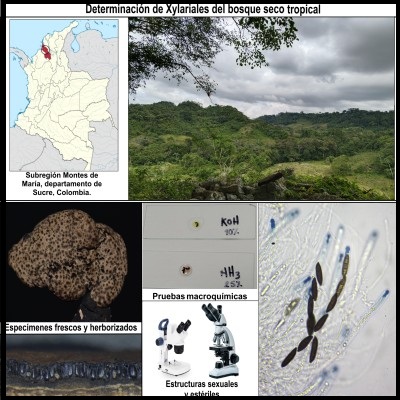
Macrofungi from the order Xylariales are well-known for their presence in tropical regions, where they play crucial roles as decomposers of plant material within ecosystems. In the department of Sucre, knowledge about local fungal biodiversity remains in its early stages, and the Tropical Dry Forest ecosystem has particularly garnered limited attention in research focused on tropical macrofungi. This study aims to enhance knowledge of fungal diversity in the Montes de María natural region by identifying macrofungi species from the order Xylariales present in the area. Among these, six represent new records for Sucre, while two species—Xylaria mesenterica and Phylacia surinamensis—are newly recorded for Colombia. This research contributes to a greater understanding of the diversity of these species, both at the national level and within the context of the tropical dry forest.
Downloads
References
Meier C. L., Rapp J., Bowers R. M., Silman M., Fierer N. Fungal growth on a common wood substrate across a tropical elevation gradient: temperature sensitivity, community composition, and potential for above-ground decomposition. Soil Biology and Biochemistry 42(7) (2010) 1083-1090. https://doi.org/10.1016/j.soilbio.2010.03.005
Purahong W., Wubet T., Lentendu G., Hoppe B., Jariyavidyanont K., Arnstadt T., et al. Determinants of deadwood-inhabiting fungal communities in temperate forests: molecular evidence from a large scale deadwood decomposition experiment. Frontiers in Microbiology, 9 (2018) 2120.
Almeida R. F. de, Lücking R., Vasco-Palacios A., Gaya E., Diazgranados M. (Eds.) Catalogue of Fungi of Colombia. Royal Botanic Gardens, Kew & Instituto de Investigación de Recursos Biológicos Alexander von Humboldt (2022) 510 pp.
Lombana-Álvarez P., Monterroza-Álvarez J. A., Chamorro-Quiroz L. F., Franco-Molano A. E., Payares-Díaz I. R. Nuevos registros de macromicetos para Colombia. Actualidades Biológicas 38(105) (2016) 181-189.
Raymundo T., Martínez-Pineda M., Osorio-Navarro Y. S., Chamorro-Martínez H. A., Valenzuela R. Primer registro de Macrovalsaria megalospora (Dothideomycetes-Ascomycota) en Colombia. Acta Botánica Mexicana (127) (2020).
Burbano-Figueroa O. Sistemas agroforestales de aguacate antillano en Montes de María (Colombia): un modelo conceptual del sistema de producción. Revista Chapingo. Serie Horticultura 25(2) (2019) 75-102.
Ministerio de Ambiente y Desarrollo Sostenible. Programa Nacional para la Conservación y Restauración del Bosque Seco Tropical en Colombia (PNCBST) (2021).
Herazo Vitola F., Mercado Gómez J., Mendoza Cifuentes H. Estructura y composición florística del bosque seco tropical en los Montes de María (Sucre-Colombia). Ciencia en Desarrollo 8(1) (2017) 71-82.
Programa de las Naciones Unidas para el Desarrollo PNUD, Corporación Territorios, Universidad de Cartagena. Programa de Desarrollo y Paz de los Montes de María. Bogotá: PNUD (2003) 162 p.
Munsell® Soil Color Charts. Munsell soil color charts. Macbeth Division of Kollmorgen Instruments Corporation, New Windsor, NY (1994).
McKnight K. H., Rayner R. W. A mycological colour chart. Mycologia 64(1) (1972) 230.
Fournier J., Lechat C., Courtecuisse R., Moreau P.-A. The genus Hypoxylon (Xylariaceae) in Guadeloupe and Martinique (French West Indies). Ascomycete.org 9(6) (2015) 171-208.
Fournier J., Lechat C., Courtecuisse R. The genus Xylaria sensu lato (Xylariaceae) in Guadeloupe and Martinique (French West Indies) II: Taxa with robust upright stromata. Ascomycete.org 12(3) (2020) 81-164.
Fournier J., Lechat C., Courtecuisse R. The genus Xylaria sensu lato (Xylariaceae) in Guadeloupe and Martinique (French West Indies) III: Taxa with slender upright stromata. Ascomycete.org 12(3) (2020) 81-164. https://doi.org/10.25664/ART-0302
Reyes P. E., Valenzuela R., Raymundo T. The genus Hypoxylon (Xylariales, Ascomycota) in the tropical dry forest of four protected natural areas from Mexico. Acta Botánica Mexicana (127) (2020) 1-20. https://doi.org/10.21829/ABM127.2020.1680
Esteban B., Silva P. V., Robles C. A., Vignale M. Nuevos registros de Xylariales (Ascomycota) para la Argentina. Boletín de la Sociedad Argentina de Botánica 52(3) (2017) 399-407.
Dennis R. W. G. Fungus flora of Venezuela and adjacent countries (Kew Bulletin Additional Series). J. Cramer (1970).
Læssøe T., Rogers J. D., Whalley A. S. Camillea, Jongiella and light-spored species of Hypoxylon. Mycological Research 93 (1989) 121-155. https://doi.org/10.1016/S0953-7562(89)80111-X
Rogers J. D., San Martín F., Ju Y. M. Three new taxa of Camillea from Costa Rica. Sydowia 54(1) (2002) 84-90.
Rogers, J. D., San Martín, F., & Ju, Y. M. (2002). Three new taxa of Camillea from Costa Rica. Sydowia, 54(1), 84–90.
Montagne J. P. F. C. Troisième centurie de plantes cellulaires exotiques nouvelles, Décadas I, II, III y IV. Hongos cubenses. Annales des Sciences Naturelles. Botanique 17 (1842) 119-128.
Diaz S. M., Esteban B., Kuhnert E., Hladki A. I. New records of Hypoxylon (Ascomycota, Hypoxylaceae) for the Argentine Yungas. Revista del Museo Argentino de Ciencias Naturales 20(2) (2018) 229-238.
Soto-Agudelo R., Valenzuela R., Raymundo Ojeda T., Gómez-Marín G. D. Ascomicetos de los guaduales en la reserva natural La Montaña del Ocaso, departamento del Quindío, Colombia. Revista de la Academia Colombiana de Ciencias Exactas, Físicas y Naturales 40(156) (2016) 438. https://doi.org/10.18257/raccefyn.352
San Martín F. E., Ju Y., Rogers J. D. Algunas especies de Hypoxylon (Pyrenomycetes, Xylariaceae) de México. Acta Botanica Mexicana (47) (1999) 31-53.
Montagne J. P. F. C. Sylloge generum specierumque cryptogamarum. (1856) pp. 1-498.
Medel R., Rogers J. D., Guzmán G. Phylacia mexicana sp. nov. and consideration of other species with emphasis on Mexico. Mycotaxon 97 (2006) 279-290.
Saccardo P. A. Fungi veneti novi vel eritici vel mycologiae venetae addendi, 9. Michelia 1 (1978) 361-445.
Dennis R. W. G. Some xylarias of tropical America. Kew Bulletin 11(3) (1956) 401-444.
Möller A. Phycomyceten und Ascomyceten: Untersuchungen aus Brasilien. G. Fischer (1901) 310 pp.
Stadler M., Fournier J., Læssøe T., Lechat C., Tichy H. V., Piepenbring M. Recognition of hypoxyloid and xylarioid Entonaema species and allied Xylaria species from a comparison of holomorphic morphology, HPLC profiles, and ribosomal DNA sequences. Mycological Progress 7 (2008) 53-73.
San Martín González F., Rogers J. D. A preliminary account of Xylaria of Mexico. Mycotaxon 34(2) (1989) 283-373.
Trierveiler-Pereira L. Ascomycetes (Pezizomycotina, Ascomycota) de Brasil: nuevos registros y datos de distribución de las especies. Lilloa (2014) 108-115.
USDA-ARS US National Fungus Collection. Occurrence dataset (registro 4099721296). Global Biodiversity Information Facility (2025). https://www.gbif.org/occurrence/4099721296.
López C., Vasco A., Franco A. Nuevos registros de macromicetes recolectados en zonas urbanas de Medellín (Antioquia). Actualidades Biológicas 33(95) (2011) 261-274.
Caifa M. V., Gómez-Hernández M., Williams-Linera G., Ramírez-Cruz V. Functional diversity of macromycete communities along an environmental gradient in a Mexican seasonally dry tropical forest. Fungal Ecology 28 (2017) 66-75. https://doi.org/10.1016/j.funeco.2017.04.005
Li H., Guo J., Goldberg S. D., Sreekar R., Ye L., Luo X., Sysouphanthonga P., Xu J., Hyde K. D., Mortimer P. E. Fruiting patterns of macrofungi in tropical and temperate land use types in Yunnan Province, China. Acta Oecologica 91 (2018) 7-15. https://doi.org/10.1016/j.actao.2018.05.008
Cedeño-Sanchez M., Wendt L., Stadler M., Mejía L. C. Three new species of Hypoxylon and new records of Xylariales from Panama. Mycosphere 11(1) (2020) 1457-1476. https://doi.org/10.5943/mycosphere/11/1/9
Petrini L., Petrini O. Xylariaceous fungi as endophytes. Sydowia 38 (1985) 216-234.
Hyde K. D. Where are the missing fungi? Mycological Research 105(12) (2001) 1409-1412.
Aime M. C., Brearley F. Q. Tropical fungal diversity: closing the gap between species estimates and species discovery. Biodiversity and Conservation 21 (2012) 2177-2180.
Hawksworth D. L. The magnitude of fungal diversity: The 1 ± 5 million species estimate revisited. Mycological Research 105(12) (2001) 1422-1432. https://doi.org/10.1017/S0953756201004725
Kark S. Effects of ecotones on biodiversity. En S. A. Levin (Ed.), Encyclopedia of Biodiversity (2.ª ed., pp. 142-148). Elsevier (2017).
Additional Files
Published
Issue
Section
License
Copyright (c) 2026 © Autores; Licencia Universidad de Pamplona

This work is licensed under a Creative Commons Attribution-NonCommercial-NoDerivatives 4.0 International License.
© Autores; Licencia Universidad de Pamplona