Effect of cooking method on heavy metal concentrations in Hoplias malabaricus (Erythrinidae)
DOI:
https://doi.org/10.24054/bistua.v22i1.2534Keywords:
Ecotoxicology, Fish, Public health, WetlandsAbstract
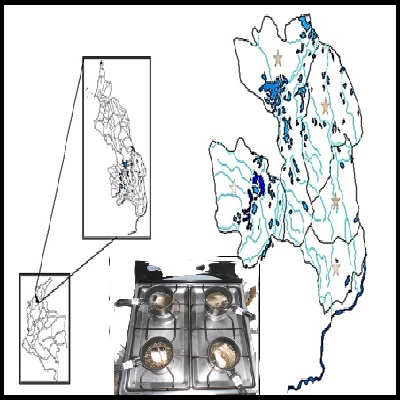
Impacts of mining and agriculture have turned mercury (Hg), methylmercury (MeHg), zinc (Zn), cadmium (Cd), lead (Pb) and copper (Cu) into common pollutants in the fish and ecosystem compartments of Colombian wetlands. For this reason, in this study we evaluated concentrations of these metals in Hoplias malabaricus muscle, and determining their variations according 5 cooking methods (Smoked, Fried, Stew, Viuda and Salpicón). The concentrations were determined by thermal decomposition, amalgamation and atomic absorption spectroscopy (EPA-7473) (Hg-MeHg), atomic absorption spectroscopy with flame (FLAAS) (EPA-7000B) (Zn-Cu) and atomic absorption spectroscopy in graphite furnace (GFAAS) (EPA-7010) (Pb-Cd).We found Zn was the metal most accumulated in this tissue, likewise Cd (Fried, Viuda, Smoked and Salpicón) and Pb (Salpicón) exceeded maximum permissible limits (EU, 2018) and FAO (1992) for mean concentrations in fish muscle for human consumption. Similarly significant differences (p<0.05) in mean concentrations of Cd and Pb in muscle cooked with Smoked in Salpicón methods were determined respect to the rest. Risk indicators (DID, HQ and HI) for health assessment of the population by consumption of Hoplias malabaricus showed La Mojana habitants are exposed to high risk level, mainly due consumption of this species cooked with Salpicón method.
Downloads
References
J. Marrugo-Negrete, L. N. Benítez, J. Olivero-Verbel, E. Lans, and F. V. Gutierrez, “Spatial and seasonal mercury distribution in the Ayapel Marsh, Mojana region, Colombia,” International Journal of Environmental Health Research, vol. 20, no. 6. Informa UK Limited, pp. 451–459, Dec. 2010. doi: 10.1080/09603123.2010.499451.
J. Marrugo Negrete, J. Pinedo-Hernández, R. Paternina–Uribe, L. Quiroz-Aguas, and S. Pacheco-Florez, “Distribución espacial y evaluación de la contaminación ambiental por mercurio en la región de la Mojana, Colombia,” Revista MVZ Córdoba, vol. 23, no. S. Universidad de Cordoba, pp. 7062–7075, Nov. 20, 2018. doi: 10.21897/rmvz.1481.
M. A. Meza Martínez et al., “Mercurio total en hígado de Trachemys callirostris (Gray, 1856) (Testudines: Emydidae) en tres zonas de la Mojana, Sucre-Colombia,” Revista U.D.C.A Actualidad & Divulgación Científica, vol. 23, no. 1. Universidad de Ciencias Aplicadas Y Ambientales - UDCA, Apr. 14, 2020. doi: 10.31910/rudca.v23.n1.2020.1239.
A. J. Zabaleta et al., “Curve Number (CN) as Pressure Indicator of the Hydrological Condition under Global Warming Scenarios at a Local Scale in La Mojana Region, Colombia,” Indian Journal of Science and Technology, vol. 11, no. 29. Indian Society for Education and Environment, pp. 1–12, Aug. 01, 2018. doi: 10.17485/ijst/2018/v11i29/129276.
M. S. Rahman, N. Saha, A. H. Molla, and S. M. Al-Reza, “Assessment of Anthropogenic Influence on Heavy Metals Contamination in the Aquatic Ecosystem Components: Water, Sediment, and Fish,” Soil and Sediment Contamination: An International Journal, vol. 23, no. 4. Informa UK Limited, pp. 353–373, Dec. 16, 2013. doi: 10.1080/15320383.2014.829025.
P. Morcillo, M. Angeles Esteban, and A. Cuesta, “Mercury and its toxic effects on fish,” AIMS Environmental Science, vol. 4, no. 3. American Institute of Mathematical Sciences (AIMS), pp. 386–402, 2017. doi: 10.3934/environsci.2017.3.386.
N. K. McRae, S. Gaw, and C. N. Glover, “Mechanisms of zinc toxicity in the galaxiid fish, Galaxias maculatus,” Comparative Biochemistry and Physiology Part C: Toxicology & Pharmacology, vol. 179. Elsevier BV, pp. 184–190, Jan. 2016. doi: 10.1016/j.cbpc.2015.10.010.
L. Song, M. G. Vijver, W. J. G. M. Peijnenburg, T. S. Galloway, and C. R. Tyler, “A comparative analysis on the in vivo toxicity of copper nanoparticles in three species of freshwater fish,” Chemosphere, vol. 139. Elsevier BV, pp. 181–189, Nov. 2015. doi: 10.1016/j.chemosphere.2015.06.021.
D. M. Templeton and Y. Liu, “Multiple roles of cadmium in cell death and survival,” Chemico-Biological Interactions, vol. 188, no. 2. Elsevier BV, pp. 267–275, Nov. 2010. doi: 10.1016/j.cbi.2010.03.040.
F. Hameed Et Al., “Hazardous Effects of Cadmium Contaminated Water on Biological Characteristics of Fish; A Review,” RHAZES: Green and Applied Chemistry, p. Vol 6 (2019), Aug. 2019, doi: 10.48419/Imist.prsm/Rhazes-v6.17566.
A. Ishaque, S. Ishaque, A. Arif, and H. Abbas, “Toxic effects of lead on fish and human,” Biological and Clinical Sciences Research Journal, vol. 2020, no. 1. Medeye Publishers, Dec. 28, 2020. doi: 10.54112/bcsrj.v2020i1.47.
C. Galeano-Páez et al., “Dietary exposure to mercury and its relation to cytogenetic instability in populations from ‘La Mojana’ region, northern Colombia,” Chemosphere, vol. 265. Elsevier BV, p. 129066, Feb. 2021. doi: 10.1016/j.chemosphere.2020.129066.
J. Marrugo Negrete, J. Pinedo Hernández, E. M. Combatt, A. G. Bravo, and S. Díez, “Flood induced metal contamination in the topsoil of floodplain agricultural soils: A case study in Colombia,” Land Degradation & Development, vol. 30, no. 17. Wiley, pp. 2139–2149, Aug. 07, 2019. doi: 10.1002/ldr.3398.
J. Mojica, J, I. Usma, R. Álvarez-León, and A. Lasso. “Libro rojo de peces dulceacuícolas de Colombia”. 2da ed. Instituto de Recursos Biológicas Alexander von Humboldt; 2012. http://hdl.handle.net/20.500.11761/34197
G. Henry, “Practical Sampling,” The SAGE Handbook of Applied Social Research Methods. SAGE Publications, Inc., pp. 77–105, 2009. doi: 10.4135/9781483348858.n3.
USEPA-IRIS. “Integrated risk information system on heavy metal exposure doses”. 2011. http://www.epa.gov/iris/
Joint FAO/WHO. “Expert committee on food additives. In: Summary and conclusions. 61st meeting: methyl mercury”. 2011. http://www.who.int/
Commission Regulation (EU). “Amending Annexes II and III to Regulation (EC) No 396/2005 of the European Parliament and of the Council as regards maximum residue levels for mercury compounds in or on certain products”. (Text with EEA. Off J. Eur. Union L, 13 (2018), pp. 8-20. 2018. ELI: http://data.europa.eu/eli/reg/2018/73/oJ
FAO. “Committee for in land fisheries of Africa; Report of the 3rd edn session of the working party on pollution and fisheries”. Accra, Ghana. Nov 1992;25-29. FAO Fisheries. Rep, No. 471. Rome, FAO, p 43
J. Marrugo-Negrete, S. Vargas-Licona, J. A. Ruiz-Guzmán, S. Marrugo-Madrid, A. G. Bravo, and S. Díez, “Human health risk of methylmercury from fish consumption at the largest floodplain in Colombia,” Environmental Research, vol. 182. Elsevier BV, p. 109050, Mar. 2020. doi: 10.1016/j.envres.2019.109050.
S. P. Vargas Licona and J. L. Marrugo Negrete, “Mercurio, metilmercurio y otros metales pesados en peces de Colombia: riesgo por ingesta,” Acta Biológica Colombiana, vol. 24, no. 2. Universidad Nacional de Colombia, pp. 232–242, May 01, 2019. doi: 10.15446/abc.v24n2.74128.
J. L. Marrugo-Negrete, J. A. Ruiz-Guzmán, and A. C. Ruiz-Fernández, “Biomagnification of Mercury in Fish from Two Gold Mining-Impacted Tropical Marshes in Northern Colombia,” Archives of Environmental Contamination and Toxicology, vol. 74, no. 1. Springer Science and Business Media LLC, pp. 121–130, Oct. 17, 2017. doi: 10.1007/s00244-017-0459-9.
J. Marrugo-Negrete, J. Pinedo-Hernández, and S. Díez, “Assessment of heavy metal pollution, spatial distribution and origin in agricultural soils along the Sinú River Basin, Colombia,” Environmental Research, vol. 154. Elsevier BV, pp. 380–388, Apr. 2017. doi: 10.1016/j.envres.2017.01.021.
J. Marrugo-Negrete, J. Pinedo-Hernández, and S. Díez, “Assessment of heavy metal pollution, spatial distribution and origin in agricultural soils along the Sinú River Basin, Colombia,” Environmental Research, vol. 154. Elsevier BV, pp. 380–388, Apr. 2017. doi: 10.1016/j.envres.2017.01.021.
A. F. Rúa Cardona, M. T. Flórez Molina, and J. Palacio Baena, “Variations of seasonal and spatial Hg, Pb, Cr and organic matter contents in Ayapel Flood Plain Lake sediments, Córdoba, northwest Colombia,” Revista Facultad de Ingeniería Universidad de Antioquia, no. 69. Universidad de Antioquia, pp. 244–255, Jan. 20, 2014. doi: 10.17533/udea.redin.18153.
M. Walaszek, P. Bois, J. Laurent, E. Lenormand, and A. Wanko, “Urban stormwater treatment by a constructed wetland: Seasonality impacts on hydraulic efficiency, physico-chemical behavior and heavy metal occurrence,” Science of The Total Environment, vol. 637–638. Elsevier BV, pp. 443–454, Oct. 2018. doi: 10.1016/j.scitotenv.2018.04.325.
J. S. Silva, A. C. A. El-Deir, G. J. B. Moura, R. R. N. Alves, and U. P. Albuquerque, “Traditional Ecological Knowledge About Dietary and Reproductive Characteristics of Tupinambis merianaeand Hoplias malabaricusin Semiarid Northeastern Brazil,” Human Ecology, vol. 42, no. 6. Springer Science and Business Media LLC, pp. 901–911, Aug. 23, 2014. doi: 10.1007/s10745-014-9698-9.
H. M. Leung et al., “Assessment of heavy metals/metalloid (As, Pb, Cd, Ni, Zn, Cr, Cu, Mn) concentrations in edible fish species tissue in the Pearl River Delta (PRD), China,” Marine Pollution Bulletin, vol. 78, no. 1–2. Elsevier BV, pp. 235–245, Jan. 2014. doi: 10.1016/j.marpolbul.2013.10.028.
E. Kondera, K. Lugowska, and P. Sarnowski, “High affinity of cadmium and copper to head kidney of common carp (Cyprinus carpio L.),” Fish Physiology and Biochemistry, vol. 40, no. 1. Springer Science and Business Media LLC, pp. 9–22, Jun. 12, 2013. doi: 10.1007/s10695-013-9819-1.
S. Rajeshkumar, Y. Liu, J. Ma, H. Y. Duan, and X. Li, “Effects of exposure to multiple heavy metals on biochemical and histopathological alterations in common carp, Cyprinus carpio L.,” Fish & Shellfish Immunology, vol. 70. Elsevier BV, pp. 461–472, Nov. 2017. doi: 10.1016/j.fsi.2017.08.013.
B. Ersoy, “Effects of cooking methods on the heavy metal concentrations of the African catfish (Clarias gariepinus),” Journal of Food Biochemistry, vol. 35, no. 2. Hindawi Limited, pp. 351–356, Mar. 04, 2011. doi: 10.1111/j.1745-4514.2010.00386.x.
K. Marimuthu, M. Thilaga, S. Kathiresan, R. Xavier, and R. H. M. H. Mas, “Effect of different cooking methods on proximate and mineral composition of striped snakehead fish (Channa striatus, Bloch),” Journal of Food Science and Technology, vol. 49, no. 3. Springer Science and Business Media LLC, pp. 373–377, Jul. 06, 2011. doi: 10.1007/s13197-011-0418-9.
J. Moreda-Piñeiro et al., “In-vivo and in-vitro testing to assess the bioaccessibility and the bioavailability of arsenic, selenium and mercury species in food samples,” TrAC Trends in Analytical Chemistry, vol. 30, no. 2. Elsevier BV, pp. 324–345, Feb. 2011. doi: 10.1016/j.trac.2010.09.008.
O. Ouédraogo and M. Amyot, “Effects of various cooking methods and food components on bioaccessibility of mercury from fish,” Environmental Research, vol. 111, no. 8. Elsevier BV, pp. 1064–1069, Nov. 2011. doi: 10.1016/j.envres.2011.09.018.
O. Ouédraogo and M. Amyot, “Effects of various cooking methods and food components on bioaccessibility of mercury from fish,” Environmental Research, vol. 111, no. 8. Elsevier BV, pp. 1064–1069, Nov. 2011. doi: 10.1016/j.envres.2011.09.018.
I. A. Sthanadar, A.A. Sthanadar, M. Shah, M, et al. “White muscle as a bio-indicator of cadmium (Cd) pollution across Kalpani River Mardan, Khyber Pakhtunkhwa Pakistan,” International Journal of Biosciences (IJB), vol. 3, no. 10. International Journal of Biosciences, pp. 105–116, Oct. 05, 2013. doi: 10.12692/ijb/3.10.105-116.
A. Galitsopoulou, D. Georgantelis, and M. Kontominas, “The influence of industrial-scale canning on cadmium and lead levels in sardines and anchovies from commercial fishing centres of the Mediterranean Sea,” Food Additives and Contaminants: Part B, vol. 5, no. 1. Informa UK Limited, pp. 75–81, Mar. 2012. doi: 10.1080/19393210.2012.658582.
E. Gheisari, M. Raissy, E. Rahimi. “The effect of different cooking methods on lead and cadmium contents of shrimp and lobster”. J. Food Biosci. Technol. 2016;6: 53–58. https://jfbt.srbiau.ac.ir/article_8911_03c3f8b54b7f6da69aaa74e81ecef213.pdf
K. Joyce and E. BO, “Effects of Different Cooking Methods on Heavy Metals Level in Fresh and Smoked Game Meat,” Journal of Food Processing & Technology, vol. 7, no. 9. OMICS Publishing Group, 2016. doi: 10.4172/2157-7110.1000617.
C. R. Calao and J. L. Marrugo, “Efectos genotóxicos en población humana asociados a metales pesados en la región de La Mojana, Colombia, 2013,” Biomédica, vol. 35, no. 0. Instituto Nacional de Salud (Colombia), May 04, 2015. doi: 10.7705/biomedica.v35i0.2392.
S. M. Diaz, R. M. Palma, M. N. Muñoz, C. Becerra-Arias, and J. A. Fernández Niño, “Factors Associated with High Mercury Levels in Women and Girls from The Mojana Region, Colombia, 2013–2015,” International Journal of Environmental Research and Public Health, vol. 17, no. 6. MDPI AG, p. 1827, Mar. 11, 2020. doi: 10.3390/ijerph17061827.
C. H. Fløtre, K. Varsi, T. Helm, B. Bolann, and A.-L. Bjørke-Monsen, “Predictors of mercury, lead, cadmium and antimony status in Norwegian never-pregnant women of fertile age,” PLOS ONE, vol. 12, no. 12. Public Library of Science (PLoS), p. e0189169, Dec.05, 2017. doi: 10.1371/journal.pone.0189169.
Downloads
Published
Versions
- 2024-06-21 (3)
- 2024-06-21 (2)
- 2023-12-20 (1)
Issue
Section
License
Copyright (c) 2023 Maira Alejandra Discuviche Rebolledo, Luty Gómez Cáceres, Carlos Ramón Vergara Rivera, Karen María De Hoyos Correa

This work is licensed under a Creative Commons Attribution-NonCommercial-NoDerivatives 4.0 International License.